
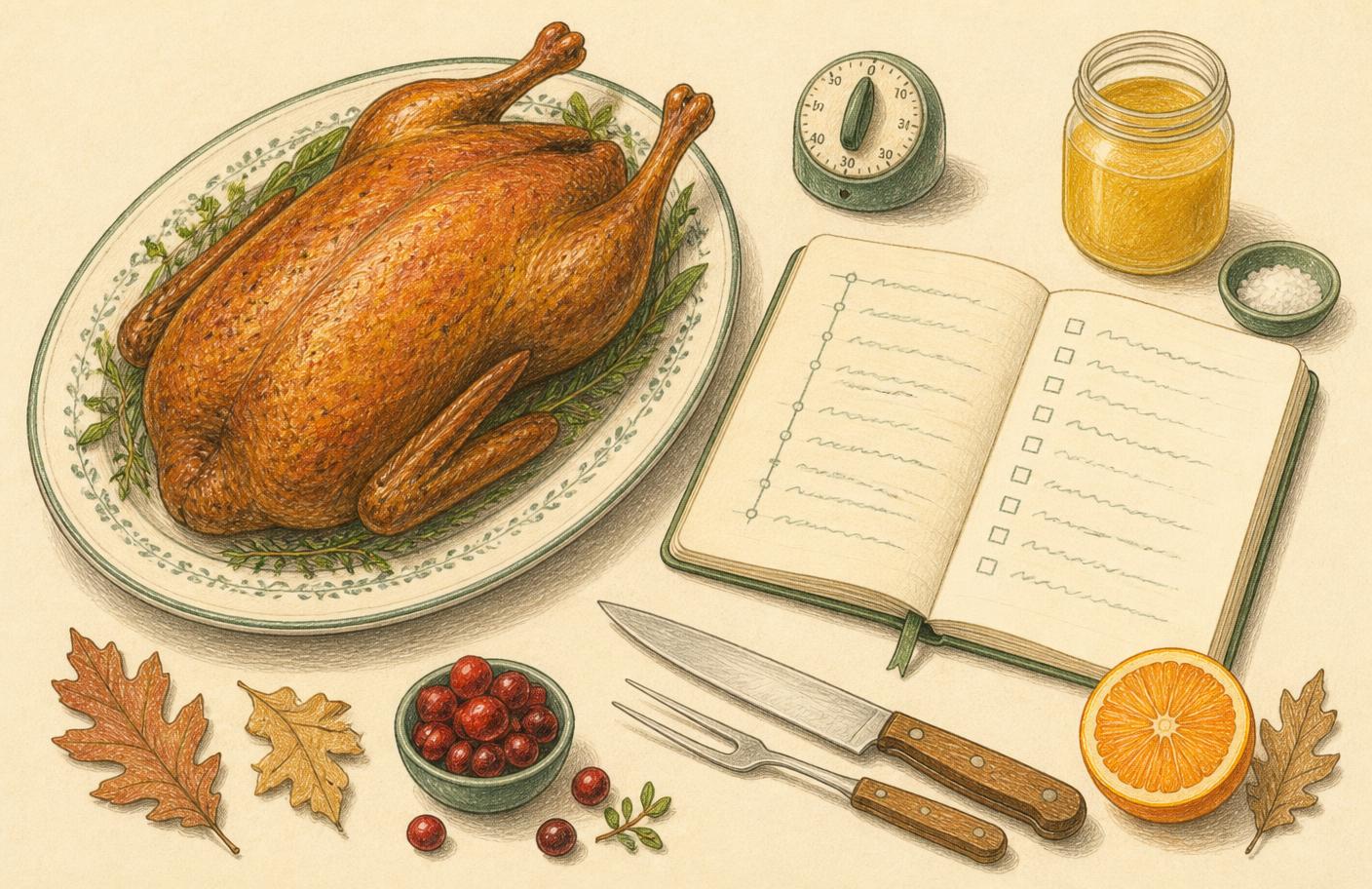
The short answer
Plan it backward from dinner. Choose your table size first, take the bird count from the serving calculator, and order two to three weeks out so you can confirm size, format and delivery date; if it arrives frozen, move it to the refrigerator two or three days ahead — about 24 hours of thawing per 4 to 5 lb. Salt it uncovered overnight, roast it on a rack so it never sits in its own fat, and finish at 165°F (73.9°C) in the thigh. Roast the duck-fat potatoes earlier in the day and re-crisp them while the bird rests for twenty minutes, and build the menu around acidity and bitter greens rather than more butter.
Updated
Choose your table first
Almost every holiday duck problem starts as a table-size problem. Find your table below, then let the calculator set the quantity.
2 to 4 guests
One whole duck as the centrepiece
Suits: A small table that wants the bird to be the event, and a cook who would rather roast one thing well than juggle two ovens.
Tradeoff: Yield is the constraint, not flavour: a single duck is generous for a small table and thin for a stretched one, so let the calculator set the weight rather than trusting a headline serving count.
5 to 8 guests
Calculator-led bird count, plus a capacity check
Suits: A full family table that still wants duck as the main event, with someone willing to plan the kitchen as carefully as the menu.
Tradeoff: This is usually two birds or a bird plus extra legs, which means checking three things before you order: pan and rack space, refrigerator shelf space for the thaw, and whether both birds fit your oven with air around them.
Larger or mixed tables
Duck alongside turkey, or duck as a portioned course
Suits: Big or traditional tables where turkey is expected, and hosts who want duck on the table without rebuilding the whole meal around it.
Tradeoff: Two whole birds rarely share one oven comfortably. Time the duck so its 20-minute rest overlaps the turkey's final cooking or resting window; if the two schedules will not meet there, use a second oven or serve duck as a portioned course — breasts or confit legs — rather than holding a whole cooked duck for a long wait.
Whichever row you are in, the number of birds comes from the same place — your guest count, run through the calculator, with its planning assumptions on show.
The countdown, working backward from dinner
A duck holiday is easier than a turkey one in the oven and harder in the calendar. The bird arrives frozen, thaws slowly, and roasts fast — so the only part that goes wrong is the part you leave to the week itself. Fix the dates first and the day looks after itself.
| When | What you do | Why it sits here |
|---|---|---|
| Three weeks out | Settle guest count and bird count | Everything downstream — order size, oven space, thaw time — depends on this number |
| Two to three weeks out | Order the duck | Ordering early is what lets you verify size, format and delivery date instead of hoping |
| One week out | Confirm pan, rack and fridge space | A thawing bird and a loaded roasting pan both need room you may not have |
| Two to three days out | Move the duck to the refrigerator | Refrigerator thawing runs about 24 hours per 4 to 5 lb, and it cannot be rushed safely |
| The night before | Salt the bird, uncovered on a rack | A dry, seasoned skin surface is most of what makes it crisp |
| Roasting day, morning | Back-time the oven from your serving hour | Include the rest — carving into a bird straight from the oven costs you juice |
One oven, several dishes, a lot of fat
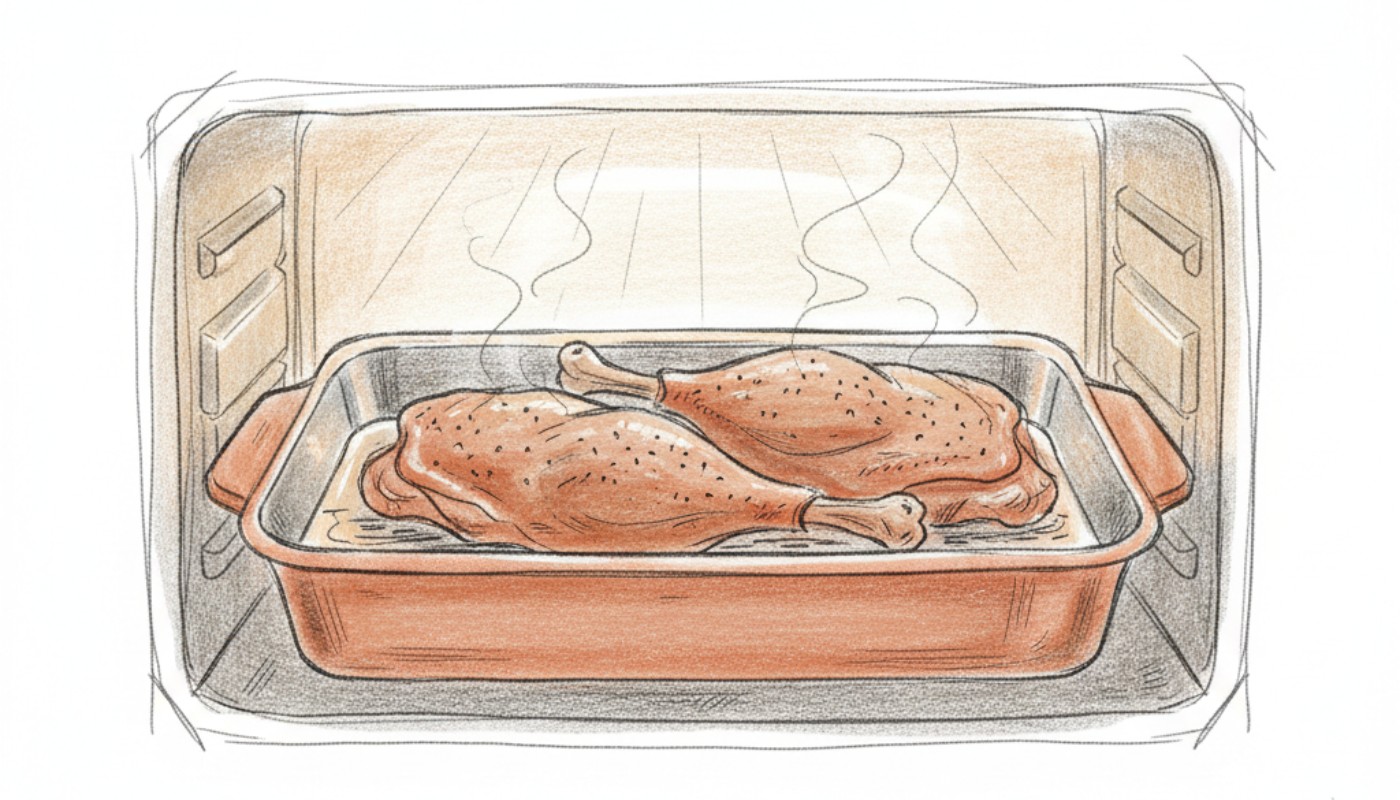
The duck is not the hard part of the schedule; the sides are. A whole duckling of 4 to 6 lb runs roughly 30 to 35 min/lb at 350°F as a planning figure, which is short enough that the bird can go in after the dishes that need a hot oven and still land on time. Keep it on a rack so it is never sitting in what it renders, and pour that fat off into a heatproof jar as it collects.
| Slot | What's in the oven | What you're doing meanwhile |
|---|---|---|
| Morning | Potatoes: parboiled, then roasted in duck fat until nearly done | Bird stays covered in the refrigerator; prep vegetables and make the sauce base |
| Mid-afternoon | Anything else that bakes hot and holds | Set the table, chill the drinks, pull the potatoes out and leave them on their tray |
| Two to three hours out | The duck, on a rack | Pour off fat as it collects, baste nothing |
| Final 30 minutes | Duck, oven turned up to finish the skin | Thermometer in the thigh, sauce finished |
| Rest, 20 minutes | Potatoes back in, uncovered, for 10 to 12 minutes to re-crisp | Carve at the end of the rest, not the start |
A menu built against the richness
A turkey table needs flavour added to it. A duck table needs flavour set against it. That one difference rewrites the menu: less butter and cream, more acidity, tart fruit, bitter leaves, and something briny somewhere on the plate.
| Role on the plate | What to serve | Why it works |
|---|---|---|
| The acid | Cranberry with real tartness, sour cherry, or an orange-led sauce | Cuts the fat and resets the palate between bites |
| The bitter | Chicory, radicchio, braised greens, shaved fennel | Bitterness reads as relief next to dark, rich meat |
| The starch | Potatoes roasted in the fat you poured off the bird | The best use of the by-product, and the dish guests remember |
| The savoury accent | Pickles, olives, capers in a dressing, mustard on the side | Salt and brine keep a rich plate from going flat |
| Restrained sweetness | One sweet dish, not four | Duck already reads luxurious; candied everything buries it |
If you want the sauce decided rather than debated, our orange-with-duck guide covers the gastrique route that keeps it tart, and best acid for duck is the short version for everything else.
The numbers that are not negotiable
Two of them decide the day: the thawing schedule and the finished temperature. Everything else on this page is planning.
The lower pull temperatures you see quoted for duck are a restaurant convention for a seared, pink breast, and they are a separate question from a whole holiday bird. For a centrepiece you are serving to a table of guests, use the thigh reading above and see duck breast temperature and doneness for where the two diverge.
Safety references
- Safe Minimum Internal Temperature Chart — USDA Food Safety and Inspection ServiceAll poultry, including duck and duck pieces, is listed at a 165°F (73.9°C) safe minimum internal temperature.Reference checked 2026-08
- Duck and Goose from Farm to Table — USDA Food Safety and Inspection ServiceHandling, labelling, storage and cooking guidance specific to duck and goose.Reference checked 2026-08
- The Big Thaw — Safe Defrosting Methods — USDA Food Safety and Inspection ServiceRefrigerator, cold-water and microwave thawing are the three methods considered safe; room-temperature thawing is not.Reference checked 2026-08
- Danger Zone (40°F – 140°F) — USDA Food Safety and Inspection ServicePerishable food should not sit between 40°F and 140°F for more than two hours.Reference checked 2026-08
- Leftovers and Food Safety — USDA Food Safety and Inspection ServiceCooked poultry keeps 3–4 days refrigerated; reheat to 165°F.Reference checked 2026-08
- Stuffing and Food Safety — USDA Food Safety and Inspection ServiceUSDA recommends cooking stuffing separately for optimal safety and uniform doneness; if poultry is stuffed, the center of the stuffing must reach 165°F measured with a food thermometer.Reference checked 2026-08
What actually goes wrong on the day
Four failures account for nearly every disappointing holiday duck, and all four are scheduling problems wearing a cooking costume.
| What happens | Why | The fix |
|---|---|---|
| Still frozen at the centre | The thaw started a day too late | Count back from dinner at roughly 24 hours per 4 to 5 lb, and add a buffer day |
| Soft, pale skin | A wet surface went into the oven | Salt uncovered on a rack overnight, pat dry, and finish hot |
| Smoking oven, greasy pan | The bird sat in its own rendered fat | Use a rack and pour the fat off into a jar as it collects |
| Dry breast, underdone legs | Carved to the clock instead of a thermometer | Read the thigh, rest 20 minutes, and take the legs off first when you carve |
Still deciding between duck and turkey?
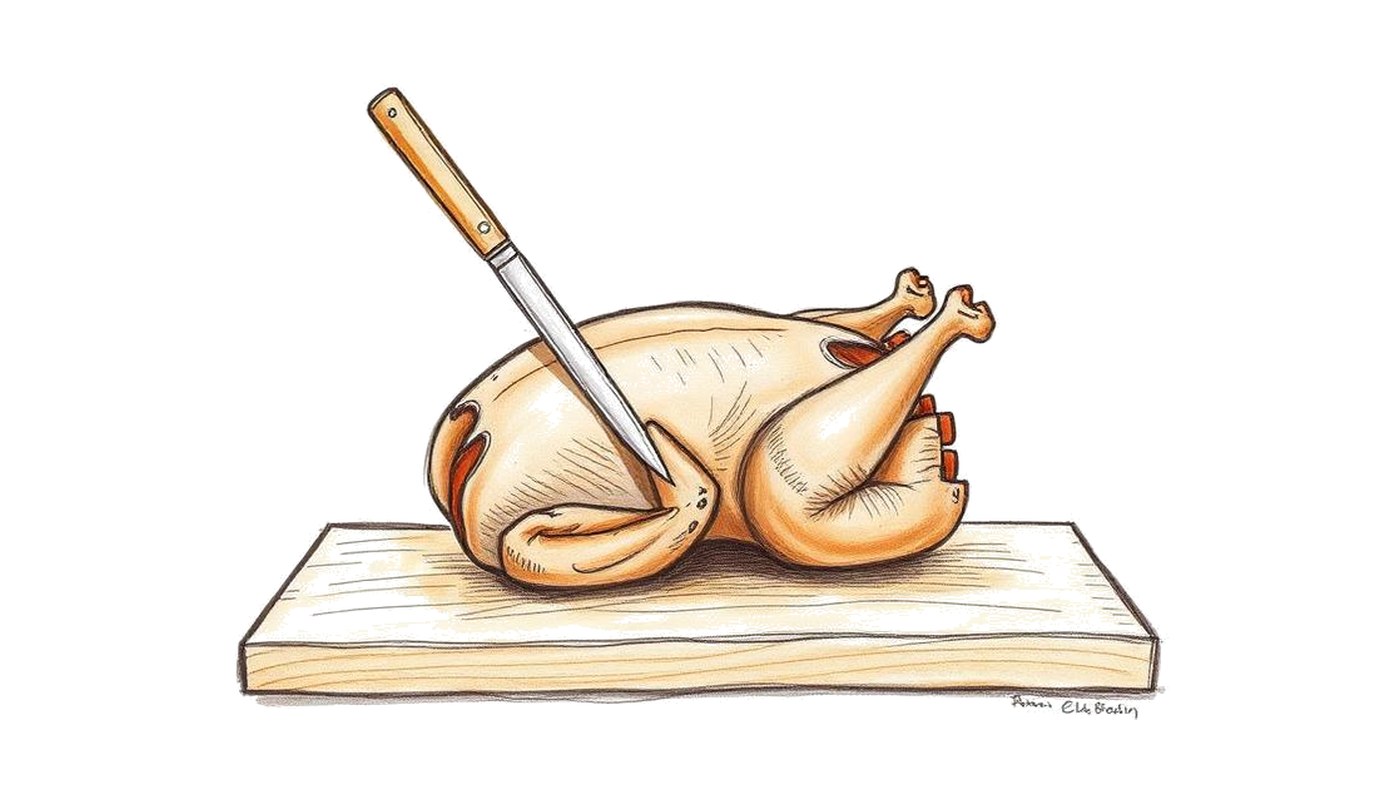
This page assumes you have chosen duck. If you have not, that is a genuinely different question — serving capacity, leftovers, guest expectations, and how much of your attention the oven gets. Our duck versus turkey comparison settles it honestly, then sends you back here to plan.
The plan, from ordering to carving
Ten decisions in the order a holiday actually makes them. Each one links to the page that finishes it.
Settle the numbers
Three weeks out
Work out how many birds
Duck yields less meat per pound than a turkey, so the guest count decides whether this is one bird, two, or a bird plus extra legs.
Linked once, under Choose your table
Order and thaw
Two to three weeks out
Place the order
Shop early enough to check what a seller actually has, what format it arrives in, and which delivery dates they offer — then work the thaw around that.
Linked once, under Get the bird and essential tools
Two to three days out
Start the thaw
A frozen whole duck thaws in the refrigerator, not on the counter, and that takes longer than most holiday schedules allow for.
Cook the bird
The day before
Back-time the oven
Put your bird weight in and get a serving time you can build the rest of the meal around, rest included.
The day before
Check the pan fits
A holiday duck needs a rack and clearance from its own rendered fat. Measure the loaded pan against your oven before the day, not on it.
Linked once, under Get the bird and essential tools
Roasting day
Cook it from the recipe
Weights, oven settings and the order of the steps, written as a recipe you can stand over rather than a discussion of method.
Roasting day
Understand the method behind it
Why the skin is dried, what the poured-off fat is doing to the pan, and how the finish crisps it — the reasoning the recipe assumes.
The last half hour
Call it by temperature
The clock gets you close; a reading in the thickest part of the thigh is what actually ends the roast.
Linked once, under Get the bird and essential tools
Carve and serve
After the rest
Carve for the table
A duck comes apart differently from a turkey: legs at the joint, breasts off in one piece, then sliced.
Made ahead, re-crisped at the end
Use the fat you poured off
Roast the potatoes in duck fat earlier in the day, then give them ten to twelve minutes uncovered while the duck rests.
Made ahead, if the render falls short
Buy rendered duck fat instead
One duck's drippings may not stretch across a full holiday spread — potatoes for a crowd, plus everything else. A tub of rendered fat covers the gap without an extra render mid-week.
Linked once, under Get the bird and essential tools
Get the bird and essential tools
Three decisions worth making before the week of the holiday. These are our own buyer guides, not checkout links — each explains what to look for, and any commercial relationships are disclosed on the guide itself.
Place the order
Shop early enough to check what a seller actually has, what format it arrives in, and which delivery dates they offer — then work the thaw around that.
Check the pan fits
A holiday duck needs a rack and clearance from its own rendered fat. Measure the loaded pan against your oven before the day, not on it.
Call it by temperature
The clock gets you close; a reading in the thickest part of the thigh is what actually ends the roast.
Buy rendered duck fat instead
One duck's drippings may not stretch across a full holiday spread — potatoes for a crowd, plus everything else. A tub of rendered fat covers the gap without an extra render mid-week.
Nothing wasted on Friday
A duck leaves more behind than a turkey does, and most of it is worth keeping. Refrigerate the cooked meat within two hours of it leaving the oven — one hour if the kitchen is above 90°F (32.2°C) — eat it within three to four days, and reheat it to 165°F (73.9°C). The carcass makes a good stock if you simmer it the same day or freeze it whole for later; picked meat is best warmed through gently in a little of the fat rather than blasted in a hot oven.
The fat in the jar
Strain what you poured off while it is still warm, into a clean jar, and refrigerate it. It is the best roasting fat in the kitchen and the reason Friday's potatoes are better than Thursday's.
What to do with it next
Potatoes first, then everything else it improves — vegetables, eggs, a confit later in the winter. A jar of duck fat is a week of better cooking, not a novelty.
The printable plan
Everything on this page that has a deadline, as a checklist you can put on the refrigerator door. No email required.
Three weeks out
- Guest count settled, and bird count taken from the serving calculator
- Raw weight to order written down
Ordering
- Seller checked for what they actually have in the size you need
- Format confirmed: fresh or frozen, and how it will be packed
- Delivery date confirmed and written on the calendar
- Thawing days counted back from dinner from that delivery date
One week out
- Roasting pan and rack found, and the loaded pan measured against the oven
- Instant-read thermometer located and tested in boiling water
- Refrigerator shelf cleared for a covered, thawing bird
- Oven plan written for the day: what goes in, in what order
Two to three days out
- Duck moved from freezer to refrigerator, covered, on a tray
- Make-ahead sauce base cooked and refrigerated
- Make-ahead sides prepared, including potatoes part-roasted in duck fat if you have it
The night before
- Bird patted dry, salted, and left uncovered on a rack in the refrigerator
- Backward cooking schedule written from your serving hour, rest included
Roasting day
- Duck goes in at the scheduled time; fat poured off into a heatproof jar as it collects
- Thigh reads 165°F (73.9°C) away from bone before the bird comes out
- Bird rests while the potatoes re-crisp uncovered
- Carve after the rest: legs off at the joint first, then the breasts, then sliced
Afterwards
- Cooked duck refrigerated within two hours of coming out of the oven (one hour above 90°F / 32.2°C)
- Leftovers eaten within three to four days, reheated to 165°F (73.9°C)
- Rendered fat strained into a clean jar and refrigerated
What this page is based on
- USDA safe-handling guidance for poultry: refrigerator thawing, the 165°F minimum internal temperature, danger-zone limits, leftover windows, and cooking stuffing separately.
- USDA's duck and goose guidance, including its approximate planning range of 30 to 35 min/lb at 350°F for a 4 to 6 lb whole duckling and its advice not to stuff a whole duckling.
- Our own whole-duck pages for the roast workflow, carving order, and fat handling, plus the published planning assumptions inside our whole-duck serving calculator.
- Menu logic from our own pairing and ingredient guides: acidity, tart fruit, bitter leaves, savoury accents, and restrained sweetness against rich dark meat.
Evaluation basis. Primary food-safety guidance for temperature, thawing, stuffing, and storage, plus our own stated planning assumptions for serving numbers and oven scheduling. Holiday duck pricing, formats and availability vary by seller, region and season, so confirm them with your own seller.
Common questions
- How far ahead should I order duck for Thanksgiving?
- Give yourself two to three weeks. That is long enough to check what a seller actually has in the size you want, confirm whether it arrives fresh or frozen, pick a delivery date you will be home for, and still leave two or three days of refrigerator thawing if it lands frozen. Aim for the delivery date and the cooking date to fall in different weeks, not different mornings.
- How many ducks do I need for Thanksgiving dinner?
- More birds than the same weight of turkey would suggest, because more of a duck is fat and frame. We will not put a fixed ratio on it: put your guest count into our whole-duck serving calculator, which shows the planning assumptions behind its answer and returns the number of birds and the raw weight to order. Tables of six and up usually mean two ducks, or one duck plus extra legs.
- What temperature is a whole Thanksgiving duck done at?
- 165°F (73.9°C) in the thickest part of the thigh, away from bone — the safe minimum internal temperature for all poultry. For planning only, a whole duckling of 4 to 6 lb runs roughly 30 to 35 min/lb in a 350°F oven, and a whole duckling should not be stuffed. Cook the stuffing separately in a casserole.
- Can I roast a duck and a turkey in the same oven?
- You can, but not comfortably at once. Both birds want air around them, the two planning ranges assume different oven settings, and a duck sheds a lot of fat that needs somewhere to go. If you want both, time the duck so its 20-minute rest lands inside the turkey's last stretch of cooking or its own rest, and carve the duck last. If the two schedules will not meet there, use a second oven or serve portioned duck — breasts or confit legs — rather than leaving a whole cooked duck standing for a long wait.
- What do I serve with a Thanksgiving duck?
- Build the plate against the richness. Something tart — cranberry, cherry, or an orange-led sauce — plus a bitter green like chicory or braised greens, potatoes roasted in the fat you poured off the bird, and one savoury, briny accent such as pickles or olives. Keep the sweet dishes restrained; duck does not need candied everything the way a lean turkey breast does.
- How do I handle all the rendered fat?
- Pour it off as it collects rather than letting the bird sit in it, and keep it. Strained into a clean jar and refrigerated, it is the best roasting fat in your kitchen. For the holiday itself, roast the potatoes in duck fat earlier in the day — saved fat from an earlier bird, or a jar bought for the purpose — and re-crisp them uncovered while the duck rests. Fresh potatoes take most of an hour and will not cook in a 20-minute rest.
- How long can Thanksgiving duck sit out, and how long do leftovers keep?
- Perishable food should not sit between 40°F and 140°F (4.4°C and 60°C) for more than two hours — one hour if the room is above 90°F (32.2°C). Refrigerate cooked duck within that window; it keeps three to four days, reheated to 165°F (73.9°C).
- Should I dry-brine the duck the night before?
- Yes, if you want the skin to crisp. A salted bird, uncovered on a rack in the refrigerator overnight, dries the skin surface while it seasons the meat — and a dry surface is most of the crisping battle. It also removes one job from the morning, which on this particular day matters more than it sounds.
References
- Safe Minimum Internal Temperature Chart — USDA Food Safety and Inspection ServiceAll poultry, including duck and duck pieces, is listed at a 165°F (73.9°C) safe minimum internal temperature.Reference checked 2026-08
- Duck and Goose from Farm to Table — USDA Food Safety and Inspection ServiceHandling, labelling, storage and cooking guidance specific to duck and goose.Reference checked 2026-08
- The Big Thaw — Safe Defrosting Methods — USDA Food Safety and Inspection ServiceRefrigerator, cold-water and microwave thawing are the three methods considered safe; room-temperature thawing is not.Reference checked 2026-08
- Danger Zone (40°F – 140°F) — USDA Food Safety and Inspection ServicePerishable food should not sit between 40°F and 140°F for more than two hours.Reference checked 2026-08
- Leftovers and Food Safety — USDA Food Safety and Inspection ServiceCooked poultry keeps 3–4 days refrigerated; reheat to 165°F.Reference checked 2026-08
- Stuffing and Food Safety — USDA Food Safety and Inspection ServiceUSDA recommends cooking stuffing separately for optimal safety and uniform doneness; if poultry is stuffed, the center of the stuffing must reach 165°F measured with a food thermometer.Reference checked 2026-08
Cooking duck tonight? Don't guess.
Roasting a whole duck is a timing problem before it is a cooking problem. The playbook carries the planning timeline, from thawing to resting. Tell us what you're cooking in the Duck Game Plan and we'll build your temperature, timing, crispy-skin and serving plan. Subscribers also get Duck the Fundamentals, the printable 28-page playbook, a short welcome series, and occasional DeliciousDuck recipes and guides.
- A planning timeline from thawing through carving
- Fat rendering and basting decisions for a whole bird
- Portioning guidance so you buy the right size
- A printable kitchen card with temperatures and timings
You can also read our companion article, the Duck Cooking Starter Guide, plus the temperature and doneness guide and the calculators, right now.
Related guides
- Whole-Duck Serving CalculatorTurn a guest count into how many birds to buy.
- Where to Buy Duck OnlineEight things to compare before you pay for cold-chain shipping.
- How to Thaw Duck SafelyFridge-first planning times, plus the cold-water fallback when you're late.
- Whole Roast DuckThe full workflow, from dry-fridge prep to a rested, carvable bird.
- How to Carve a Whole DuckSix moves, in the order that keeps the skin intact and the meat hot.
- Duck vs. Turkey for ThanksgivingThe verdict up front, then the tradeoffs nobody mentions until the oven is full.
- Duck Fat Roasted PotatoesParboiled, roughed up, and roasted in preheated duck fat until the outsides shatter and the insides stay fluffy.
- How Much Duck Per PersonCooked-weight portions, whole-bird yield, and when to size up.
- Roasted Whole DuckA two-stage roast that renders the fat cap, keeps the breast juicy, and gets the legs fully tender.
- Whole Duck Cooking TimePlan by weight, finish by thermometer — and why the two never fully agree.