
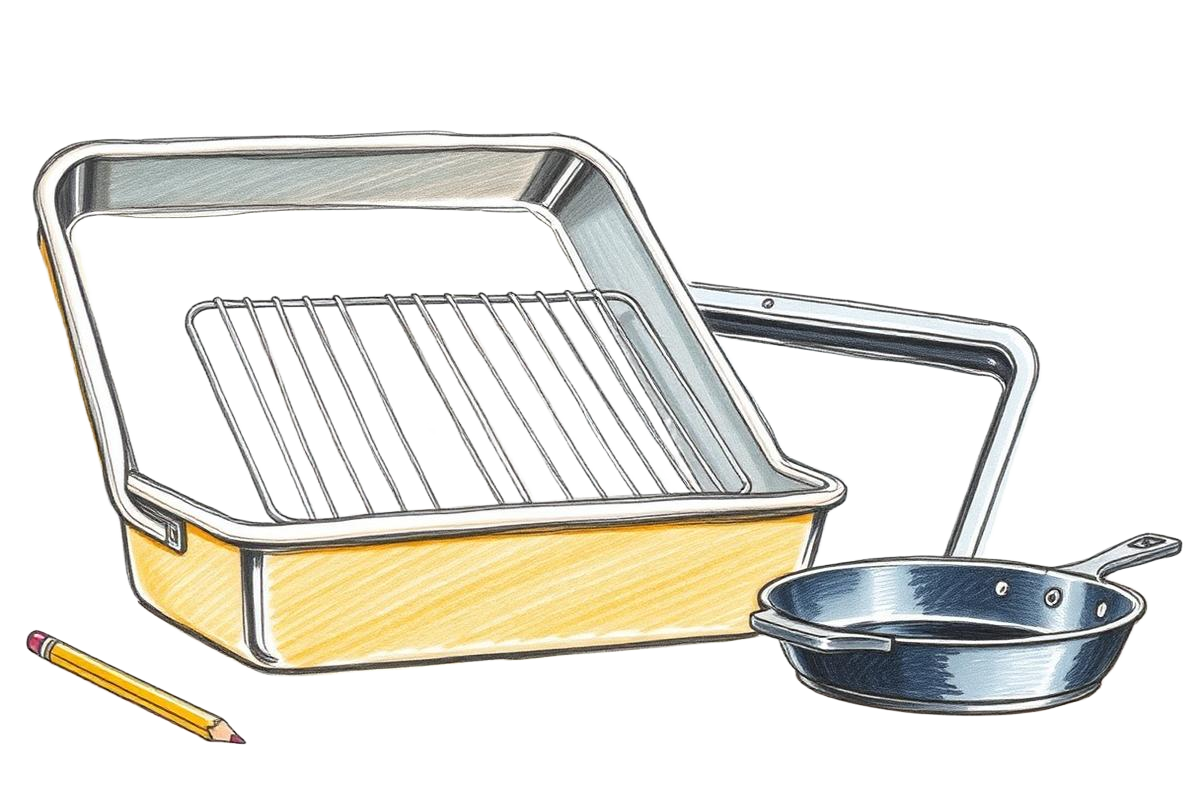
A whole duck asks two things of a roasting pan: room for the fat it renders, and a way to keep the bird out of it. Everything else — brand, finish, price — sits behind those two jobs. There's no single pan that's right for every kitchen, so this guide is about matching a setup to your bird and your oven rather than naming a winner.
The fat is the design brief
Duck renders more fat than chicken, and that fat pools in the bottom of the pan while the bird is still cooking. Skin sitting in liquid fat doesn't crisp — it cooks gently, in exactly the way you don't want on top of a roast. So the vessel has to elevate the bird and hold the render with margin to spare when you move it.
Don't throw that fat away. Strained and stored properly it's the most useful thing the bird produces — see how to render and store duck fat and what to do with it.
Sizing: measure, don't guess
Duck sizes, racks, and home ovens all vary enough that a universal set of pan dimensions would be misleading. Use this five-step fit check instead — it takes a couple of minutes with a tape measure and rules out the mistakes that actually spoil a roast.
| Step | What you're checking |
|---|---|
| 1. Measure bird and rack together | Set the duck on the rack you'll actually use and measure that whole footprint, height included. |
| 2. Choose a pan that holds them without contact | The bird shouldn't touch the sides, and air should be able to move all the way round it. |
| 3. Confirm the loaded pan fits your oven | Slide it in cold, loaded, and check you can get hands and mitts around it to lift it out. |
| 4. Check the maker's temperature and care instructions | Maximum oven temperature and cleaning guidance vary by pan — read them before you roast, not after. |
| 5. Leave capacity for the rendered fat | Enough depth that the fat isn't near the rim, with a heatproof container ready to take some off. |
If you're shopping before the bird is in the house, measure the rack and the oven now and leave yourself margin on both.
Flat rack or V rack
If you buy one thing after reading this, buy a rack that fits the pan you already own. A rack that flexes under a loaded bird can tip it into the fat part-way through the roast, which is worse than no rack at all — rigidity matters more than shape.
| Rack | Suits | Strengths | Limitations |
|---|---|---|---|
| Flat rack | Whole birds, legs, breasts, and everything else you roast | Even lift and a stable base, as long as it's rigid enough not to flex under a loaded bird | Sits lower, so the underside is closer to the fat as it collects |
| V rack | Whole birds you want cradled and steady | Holds the bird higher and keeps it from rolling; often easier to lift out with the bird on it | Shape only suits whole birds, and it takes up more storage than a flat rack |
No rack tonight? Thick slices of onion, halved carrots, or a coil of foil will lift the bird off the base. It's a workaround rather than a purchase — but a good one.
Materials, and what to check on each
- Stainless steel. The common choice for roasters and racks. Check the maker's oven-temperature rating and cleaning guidance; heavier pans generally feel more stable loaded.
- Hard-anodized aluminium. Light for its size and widely sold as oven-safe, but ratings differ by product — read the specification for the pan in front of you rather than assuming a category limit.
- Cast iron. Holds heat well and browns firmly, which suits legs and flat cuts. Season and dry it per the maker's instructions, and deglaze acidic sauces in something else.
- Glass and ceramic. Bakeware in these materials comes with its own temperature limits and thermal-shock guidance. Follow the instructions supplied with your dish; they vary by brand and aren't interchangeable.
- Nonstick and coated pans. Usable within the manufacturer's stated maximum oven temperature. Look that number up before roasting hot, and don't infer it from another pan.
- Disposable foil trays. A fallback, not an equivalent. Support the tray on a sheet pan, keep the fat level low, move it with two hands, and follow the oven-use instructions on the packaging.
Handling a hot pan of liquid fat
This is the part gear guides skip. Part-way through a duck roast you'll be moving a hot pan holding hot liquid fat. Before you buy, check that the handles are big enough to grip in oven mitts, that you can carry the pan level with two hands, and that the setup feels stable when it's loaded. To remove fat, ladle it into a heatproof container standing on a towel on the counter rather than tipping the whole pan.
The buyer's checklist
- Actual bird and rack fit. Measured together, with the bird clear of the sides and air able to move round it.
- Oven fit, loaded. The pan goes in and comes out with room for your hands and mitts.
- Maximum oven temperature. Confirmed from the manufacturer for that specific pan, coating included.
- Stable handling when loaded. Grippable handles, no worrying flex, and a level two-handed carry.
- Rack configuration. Flat or V, rigid, and sized to the pan you're buying it for.
- Cleanup and care. Dishwasher or hand-wash, seasoning needs, and how forgiving the surface is after a fatty roast.
- Storage. Where it lives the rest of the year — a pan you'll use again earns its cupboard more easily than one you won't.
Compare the four setups
| Option | Lifting the bird out of its fat | Room for rendered fat | Airflow around the skin | Fit check before you buy | Handling it loaded | Care, cleanup, and afterlife |
|---|---|---|---|---|---|---|
| Roasting pan + rack | A rack made for the pan holds the bird clear of the fat for the whole roast. | Usually the most generous of the four — sides are built to contain a render. | Good, though taller sides shade the lower skin more than a shallow pan does. | Measure your bird on its rack, then check the loaded pan clears your oven walls. | Two proper handles help, but a loaded roaster is heavy — lift it two-handed. | Follow the maker's care instructions; also earns its space on chicken and turkey. |
| Rimmed sheet pan + rack | Good, provided the rack is rigid enough to stay flat under a whole bird. | The shallowest option here — watch the level and move fat off as it collects. | Nothing shades the skin, which is the main reason cooks choose it. | Set bird and rack on the pan and confirm nothing touches the rim or oven walls. | Light to lift, but a shallow pan of hot fat is the easiest to slosh. | Check the maker's max oven temperature, especially on nonstick or coated sheets. |
| Cast-iron setup | Poor on its own — you need a rack or trivet that fits inside it. | Depends on the pan and how much of it the bird occupies. | Reduced by the sides, and least generous where the bird sits near a wall. | Check the bird sits inside without touching the sides before you commit to it. | Heaviest of the four; hot iron plus fat is the least forgiving to move. | Season and dry per the maker's instructions; deglaze acidic sauces elsewhere. |
| Disposable foil fallback | Only with a rack or trivet that the tray can actually support. | Limited, and the tray flexes as fat collects — keep the level low. | Comparable to a shallow metal pan of the same shape. | Check bird, rack, and tray together, and that the loaded tray clears the oven. | Weakest here. Support it underneath with a sheet pan and move it two-handed. | Single-use. Read the packaging for oven use and temperature instructions. |
Roasting pan + rack
Best for: Anyone who roasts whole birds more than once or twice a year.
- Lifting the bird out of its fat
- A rack made for the pan holds the bird clear of the fat for the whole roast.
- Room for rendered fat
- Usually the most generous of the four — sides are built to contain a render.
- Airflow around the skin
- Good, though taller sides shade the lower skin more than a shallow pan does.
- Fit check before you buy
- Measure your bird on its rack, then check the loaded pan clears your oven walls.
- Handling it loaded
- Two proper handles help, but a loaded roaster is heavy — lift it two-handed.
- Care, cleanup, and afterlife
- Follow the maker's care instructions; also earns its space on chicken and turkey.
Why it stands out
- The rack addresses the problem that matters most: skin sitting in fat won't crisp.
- Deeper sides give you somewhere for the fat to go before you decide to pour any off.
What to check
- Bulky to store, and oversized for anything smaller than a whole bird.
- Very tall sides shelter the lower half of the bird from moving air.
No verified seller link yet
Details checked 2026-08
Rimmed sheet pan + rack
Best for: Cooks who want maximum airflow and already own both pieces.
- Lifting the bird out of its fat
- Good, provided the rack is rigid enough to stay flat under a whole bird.
- Room for rendered fat
- The shallowest option here — watch the level and move fat off as it collects.
- Airflow around the skin
- Nothing shades the skin, which is the main reason cooks choose it.
- Fit check before you buy
- Set bird and rack on the pan and confirm nothing touches the rim or oven walls.
- Handling it loaded
- Light to lift, but a shallow pan of hot fat is the easiest to slosh.
- Care, cleanup, and afterlife
- Check the maker's max oven temperature, especially on nonstick or coated sheets.
Why it stands out
- Open convection all round the bird, which is what crisp skin wants.
- Genuinely useful the rest of the year, so storage space isn't wasted.
What to check
- Shallow sides mean less margin before fat reaches the rim — plan to remove some.
- Thin sheets can distort at roasting heat; check the manufacturer's stated limit.
No verified seller link yet
Details checked 2026-08
Cast-iron setup
Best for: Duck legs, halved or spatchcocked birds, and small kitchens.
- Lifting the bird out of its fat
- Poor on its own — you need a rack or trivet that fits inside it.
- Room for rendered fat
- Depends on the pan and how much of it the bird occupies.
- Airflow around the skin
- Reduced by the sides, and least generous where the bird sits near a wall.
- Fit check before you buy
- Check the bird sits inside without touching the sides before you commit to it.
- Handling it loaded
- Heaviest of the four; hot iron plus fat is the least forgiving to move.
- Care, cleanup, and afterlife
- Season and dry per the maker's instructions; deglaze acidic sauces elsewhere.
Why it stands out
- Retained heat browns the underside firmly, which suits legs and flat cuts.
- Stovetop to oven in one vessel, so you can render and roast in the same pan.
What to check
- Rarely the right shape for a whole bird unless it's halved or spatchcocked.
- No easy pour spout, so removing fat mid-roast wants a ladle and a steady hand.
No verified seller link yet
Details checked 2026-08
Disposable foil fallback
Best for: A holiday overflow bird, a rented kitchen, or a pan you don't own yet.
- Lifting the bird out of its fat
- Only with a rack or trivet that the tray can actually support.
- Room for rendered fat
- Limited, and the tray flexes as fat collects — keep the level low.
- Airflow around the skin
- Comparable to a shallow metal pan of the same shape.
- Fit check before you buy
- Check bird, rack, and tray together, and that the loaded tray clears the oven.
- Handling it loaded
- Weakest here. Support it underneath with a sheet pan and move it two-handed.
- Care, cleanup, and afterlife
- Single-use. Read the packaging for oven use and temperature instructions.
Why it stands out
- Cheap and available when you need another vessel at short notice.
- Nothing to store or clean afterwards.
What to check
- Thin walls flex under a loaded bird — treat a supporting sheet pan as required, not optional.
- Follow the packaging instructions; don't assume it behaves like a heavy metal roaster.
No verified seller link yet
Details checked 2026-08
Evaluation basis: published specifications, manufacturer or seller documentation, and the duck-specific cooking requirements explained in this guide. Editorial standards
Which one suits you
Roasting pan and rack if you roast whole birds a few times a year — duck, chicken, turkey at the holidays — and you'd rather have depth to spare for the fat.
Half-sheet and rack if you want open airflow, don't mind moving fat off part-way through, and would rather own a pan that works all year.
Cast iron if you're cooking legs, a halved bird, or a spatchcocked duck and want to render, roast, and build a sauce in one vessel.
A disposable foil tray if you need a second vessel at short notice — with a sheet pan underneath it and the packaging instructions followed.
Shop this guide
What this guide actually asks you to own. If you already have a working version, keep it.
A rack that fits the pan you already own
It addresses the actual problem — a bird sitting in its fat won't crisp underneath.
See the whole-roast methodA heatproof container for the render
Somewhere safe for the fat to go mid-roast, and worth keeping afterwards.
How to strain and store itAn instant-read thermometer
Pan choice changes how fast the bird cooks; temperature is the reliable signal.
What to look for in a probe
Cooking duck tonight? Don't guess.
Roasting a whole duck is a timing problem before it is a cooking problem. The playbook carries the planning timeline, from thawing to resting. Tell us what you're cooking in the Duck Game Plan and we'll build your temperature, timing, crispy-skin and serving plan. Subscribers also get Duck the Fundamentals, the printable 28-page playbook, a short welcome series, and occasional DeliciousDuck recipes and guides.
- A planning timeline from thawing through carving
- Fat rendering and basting decisions for a whole bird
- Portioning guidance so you buy the right size
- A printable kitchen card with temperatures and timings
You can also read our companion article, the Duck Cooking Starter Guide, plus the temperature and doneness guide and the calculators, right now.
Common questions
- What size roasting pan do I need for a whole duck?
- The size that fits your bird, not a number from a chart. Set the duck on the rack you plan to use, measure that footprint, and choose a pan the bird sits inside without touching the sides. Then check the loaded pan still clears your oven walls.
- Do I really need a rack?
- You need something that keeps the skin out of the rendered fat. A rack made for the pan, a rigid wire rack that fits, or a bed of thick vegetable slices all do that job. Skin sitting in liquid fat won't crisp.
- Can I roast a duck on a sheet pan?
- Yes, with a rack. Airflow is the strong point; the shallow rim is the limitation, so watch the fat level and move some off into a heatproof container as it collects rather than waiting.
- Is cast iron a good roasting vessel for duck?
- It suits legs, a halved bird, or a spatchcocked one, where the retained heat browns the underside well. For a whole bird the shape works against you: the duck sits low and the sides reduce airflow where you want it most.
- Can I use a glass or ceramic baking dish?
- Check the manufacturer's instructions first. Glass and ceramic bakeware carries its own oven-temperature limits and guidance about thermal shock — adding cold liquid to a hot dish, for example — and those instructions vary by brand, so follow the ones that came with your dish rather than a general rule.
- What about nonstick or disposable foil trays?
- Both can work within their stated limits. Nonstick pans have a maximum oven temperature set by the maker; disposable foil trays are thin, so support them on a sheet pan and follow the packaging instructions for oven use.
- How much fat will a duck render?
- It varies with the bird and how it's cooked, so we won't quote a figure. Plan for enough capacity that the pan isn't near its limit, keep a heatproof container within reach, and move fat off when the level looks high rather than at a fixed interval.
Related guides
- Whole Roast DuckThe full workflow, from dry-fridge prep to a rested, carvable bird.
- Whole Duck Cooking TimePlan by weight, finish by thermometer — and why the two never fully agree.
- How to Render Duck FatFrom trim to a clean jar, plus honest storage windows.
- Best Pan for Duck BreastThermal mass versus control, and which one your method needs.
- Best Thermometer for DuckInstant-read or leave-in? Match the tool to how you cook duck.
- Roasted Whole DuckA two-stage roast that renders the fat cap, keeps the breast juicy, and gets the legs fully tender.