
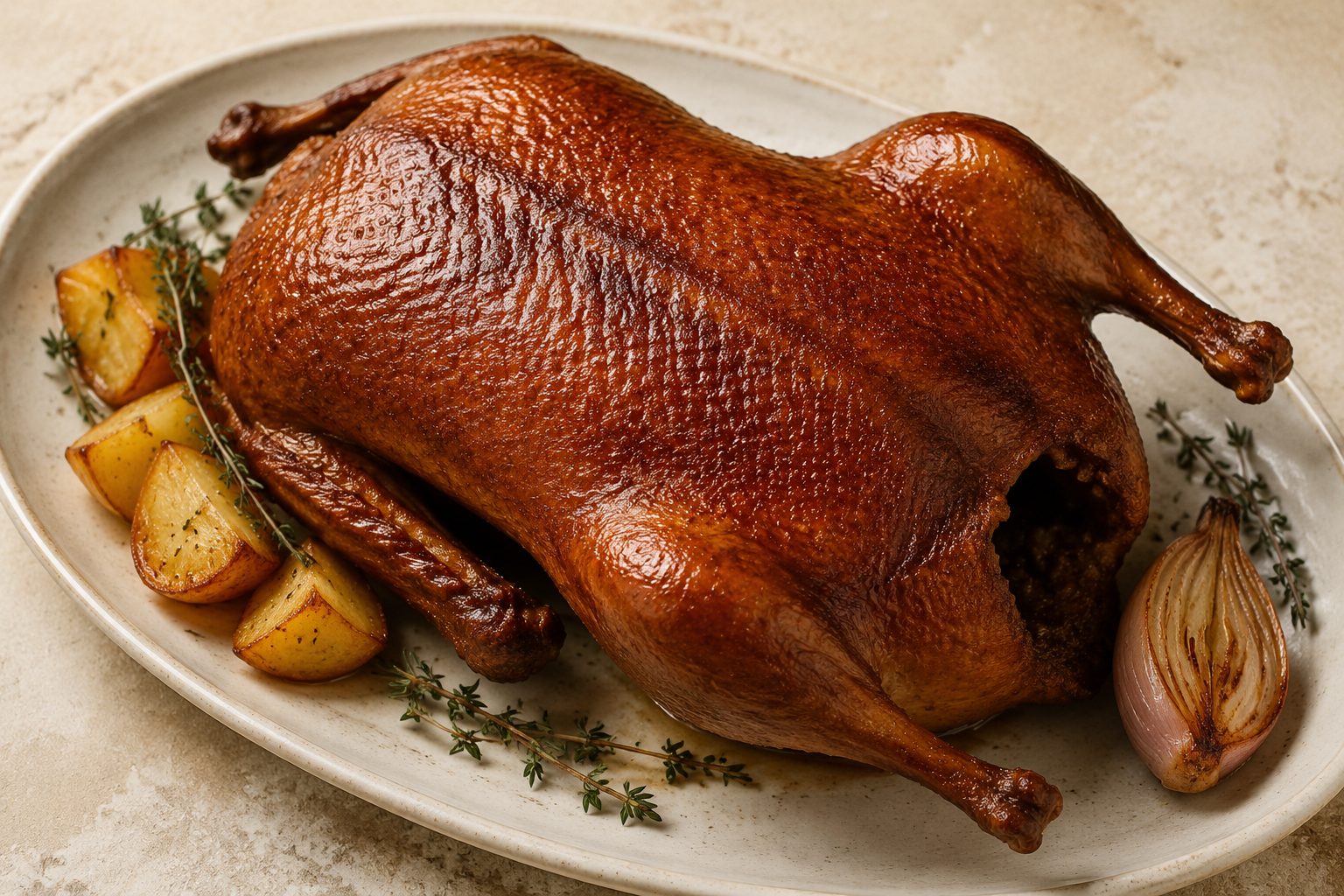
Short answer
Roast a whole duck in two stages: 60–90 minutes at 300–325°F (150–165°C) breast-side up to render the fat, pouring it off as it collects, then a short blast at high heat to crisp the skin. The legs are ready at 175–185°F (79–85°C) in the thickest part of the thigh, where the connective tissue has softened; probe there rather than trusting time. Dry the skin uncovered in the fridge overnight and keep the bird on a rack so it never sits in its own fat.
Method basis: established culinary technique and published food-safety guidance. Cook to the stated internal temperatures rather than to the clock. Editorial standards
Ingredients
For the bird
- 1 whole duck, 2–2.7 kg (4.5–6 lb), giblets removed
- 2 tsp fine sea salt
- 1 tsp cracked black pepper
- 1 lemon or orange, halved
- 4 garlic cloves, crushed
- A few sprigs thyme or rosemary
Optional glaze, last 20 minutes
- 2 tbsp honey or maple syrup
- 1 tbsp soy sauce or cider vinegar
- 1 tsp orange zest
Cooking for a different number? Scale the quantities rather than guessing — fat and salt do not scale linearly with guest count.
Equipment that matters
Roasting tin with a rack
The bird must sit above the fat it releases, or the underside braises instead of roasting — and the tin has to hold a lot of rendered fat without warping at 450°F.
Instant-read thermometer
Breast and thigh finish at very different temperatures; you need to check both.
Before you start
Dry the bird, ideally overnight
Pat it dry inside and out, salt the skin, and leave it uncovered on a rack in the fridge overnight. A dry skin is the single biggest factor in a crisp finish.
Prick, do not slash
Prick the fattiest areas — breast sides, thighs, the fat pad at the tail — at an angle with a skewer or sharp knife tip so fat drains without cutting into the meat.
Work out timing and quantity
Use the cooking-time planner for a weight-based range, and the serving calculator if you are buying for a crowd.
Method, step by step
Season and fill the cavity
Salt the skin and cavity, add the citrus halves, garlic and herbs. Do not stuff a duck with stuffing — the cavity contents are aromatics only, and a packed cavity slows the cook badly.
Stage one: render low, breast-side up
Roast at 300–325°F (150–165°C) for roughly 60–90 minutes depending on weight. Fat should collect steadily in the tin.
Watch for Pour off accumulated fat every 30 minutes — a deep pool spits and steams the underside.
Check the legs before browning
Probe the thickest part of the thigh, avoiding bone. Legs should be heading for 175–185°F (79–85°C), where connective tissue has broken down and the meat gives easily.
Stage two: brown hot and fast
Raise the oven to 425–450°F (220–230°C) for 15–25 minutes until the skin is deep mahogany and tight. If you are glazing, brush in the last 10–15 minutes only — sugar burns quickly at this heat.
Watch for Watch continuously in this stage; the gap between burnished and burnt is a few minutes.
Rest properly
Rest 15–20 minutes, loosely tented, before carving. A whole bird carries a lot of heat and the juices need time to redistribute.
Carve breast and legs separately
Remove the legs at the joint, take the breasts off the crown whole, then slice them across the grain. Carving straight down through the bird gives you ragged, uneven slices.
Temperatures and timings
| Part | Target | Why |
|---|---|---|
| Thigh / leg | 175–185°F (79–85°C) | Connective tissue breaks down; meat becomes tender |
| Breast (culinary) | 135–145°F (57–63°C) | Still juicy; commonly served slightly pink |
| USDA recommendation | 165°F (73.9°C) throughout | Food-safety minimum for all poultry |
| Rest | 15–20 minutes | Juice redistribution; carryover of several degrees |
Quack Fix
The four ways this recipe usually goes wrong, what to do about it mid-cook, and how to stop it happening again.
Breast is dry by the time the legs are done
- Likely cause
- The whole roast ran too hot, so the breast overshot while the legs caught up.
- Fix now
- Slice the breast thin and serve with the pan juices or a sharp fruit sauce.
- Prevent next time
- Use the low-then-hot two-stage method, and shield the breast with foil if it runs ahead.
Skin is pale and soft
- Likely cause
- Skin was damp going in, or the high-heat stage was skipped or too short.
- Fix now
- Return the bird to a 450°F (230°C) oven for 10 more minutes, watching closely.
- Prevent next time
- Dry the skin uncovered in the fridge overnight and commit to the hot finish.
Kitchen filled with smoke
- Likely cause
- Fat pooled in the tin and hit the high-heat stage.
- Fix now
- Pour off the fat carefully into a heatproof container and continue.
- Prevent next time
- Drain fat at every check during the low stage.
Use the Whole Duck
Nothing here needs to go in the bin. Each of these is worth more than the packaging suggests.
Rendered fat
Strain and jar it. One whole duck typically yields several hundred millilitres.
Fifteen uses for duck fatCarcass
Simmer with aromatics for a stock far richer than chicken.
Picked meat
Duck hash, fried rice, tacos, or a quick ragù.
Neck and giblets
Brown them and add to the stock pot, or make a small gravy while the bird rests.
Cooking this bird for Thanksgiving? The recipe is the easy part; the calendar is not. Order date, thaw days, a single-oven order of play and a printable checklist live in our Thanksgiving duck dinner plan
Common questions
- How long does a whole duck take to roast?
- Broadly 2–2.5 hours for a 2–2.7 kg (4.5–6 lb) bird using the two-stage method, but weight, oven accuracy and starting temperature all shift it. Use the cooking-time planner for a range and confirm with a thermometer.
- What is the best way to cook a whole duck?
- Two stages in a domestic oven: a long, low phase at 300–325°F (150–165°C) that renders the fat cap, then a short blast at high heat that crisps the skin. Cooking hot the whole way dries the breast before the legs are tender, and cooking low the whole way leaves the skin soft.
- How do I prepare a whole duck before roasting?
- Remove the giblets, dry the skin thoroughly and leave the bird uncovered in the fridge overnight if you can, season inside and out, and set it on a rack so it never sits in the fat it releases. Aromatics go in the cavity; stuffing does not.
- Should I stuff a whole duck?
- No. Stuffing insulates the cavity, extends the cook, and soaks up fat. Use citrus, garlic and herbs as aromatics instead.
- How many people does one duck serve?
- A whole duck usually serves 3–4 as a main because the carcass-to-meat ratio is lower than chicken. The serving calculator accounts for appetite and leftovers.
Related guides
The technique guides and calculators behind this recipe.
- Whole Roast DuckThe full workflow, from dry-fridge prep to a rested, carvable bird.
- Whole Duck Cooking TimePlan by weight, finish by thermometer — and why the two never fully agree.
- How to Carve a Whole DuckSix moves, in the order that keeps the skin intact and the meat hot.
- How to Thaw Duck SafelyFridge-first planning times, plus the cold-water fallback when you're late.
- Duck Cooking-Time PlannerA planning range for a whole duck by weight and oven temperature.
- Whole-Duck Serving CalculatorTurn a guest count into how many birds to buy.
- Duck Fat Roasted PotatoesParboiled, roughed up, and roasted in preheated duck fat until the outsides shatter and the insides stay fluffy.
- Duck à l’OrangeA whole duck roasted in two stages, served with a bitter-orange gastrique built from the pan drippings — sharp and glossy rather than sweet.
- Best Herbs & Spices for DuckFive flavour families, why each suits duck fat, and where each one clashes.
- Peking Duck at HomeA home cook's route to lacquered, shatter-crisp Peking-style duck: air-dry, scald, glaze, and roast, served with pancakes, scallion and hoisin.
- Duck Breast Temperature & DonenessWhat the numbers mean, and where safety guidance and kitchen practice differ.
- Thanksgiving Duck Dinner PlanChoose your table, then order date, thaw date, oven schedule and menu — with a printable checklist.
- Best Roasting Pan for DuckA rack, room for the fat, and a measured fit — the rest is preference.
- How to Render Duck FatFrom trim to a clean jar, plus honest storage windows.
- Where to Buy Duck OnlineEight things to compare before you pay for cold-chain shipping.
References
- Safe Minimum Internal Temperature Chart — USDA Food Safety and Inspection ServiceAll poultry, including duck and duck pieces, is listed at a 165°F (73.9°C) safe minimum internal temperature.Reference checked 2026-08
- Duck and Goose from Farm to Table — USDA Food Safety and Inspection ServiceHandling, labelling, storage and cooking guidance specific to duck and goose.Reference checked 2026-08