
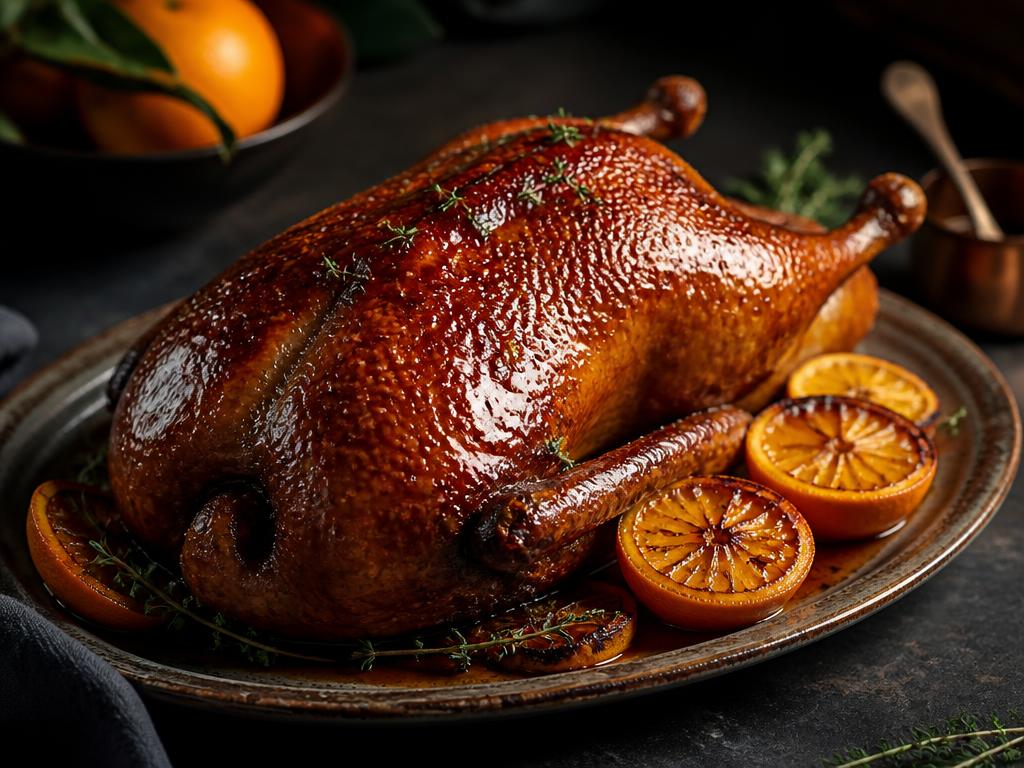
Method basis: established culinary technique and published food-safety guidance. Cook to the stated internal temperatures rather than to the clock. Editorial standards
Ingredients
For the duck
- 1 whole duck, 2–2.7 kg (4.5–6 lb), giblets removed and reserved
- 2 tsp fine sea salt
- 1 tsp cracked black pepper
- 1 orange, halved, plus 2 bay leaves for the cavity
For the orange gastrique
- Zest of 2 oranges, removed in wide strips with no white pith
- 300 ml (1¼ cups) fresh orange juice, from about 4 oranges
- 60 g (¼ cup) caster or granulated sugar
- 60 ml (¼ cup) red wine vinegar
- 250 ml (1 cup) duck or chicken stock
- 2 tsp lemon juice or extra red wine vinegar, to sharpen at the end
- 1 tsp Seville orange marmalade (optional) — for bitter-orange depth, bearing in mind it also adds sweetness
- 15 g (1 tbsp) cold unsalted butter
- Salt, to taste
Optional garnish
- 1 orange, peeled and cut into segments, pith removed
- A few sprigs thyme
Cooking for a different number? Scale the quantities rather than guessing — fat and salt do not scale linearly with guest count.
Equipment that matters
Instant-read thermometer
The legs and the breast finish 40°F apart on the same bird. A probe is the only way to know which one is holding you up.
Roasting tin with a rack
The duck has to sit above the fat it renders, and the tin has to leave air on all four sides or the skin steams instead of browning.
Heavy-based saucepan
Caramel scorches in thin pans. A heavy base gives you a few seconds of margin between amber and burnt.
Before you start
Dry the skin, ideally overnight
Pat the bird dry inside and out, salt the skin, and leave it uncovered on a rack in the fridge overnight. Nothing else you do matters as much for the finish: a damp skin spends its first half-hour evaporating water instead of rendering fat.
Prick the fat, don't cut it
Angle a skewer or the tip of a sharp knife into the breast sides, thighs and tail fat pad. You want channels for fat to drain, not openings for juice to leak.
Zest before you juice
Take the zest off in wide strips while the oranges are still whole, avoiding the white pith. Pith is where the harsh bitterness lives; the coloured skin is where the aromatic bitterness you want lives.
Plan the timing
Work out the roast window from the bird's weight before you start, and decide how much duck you actually need if you are buying for a table.
Method, step by step
Season and fill the cavity
Salt the skin and cavity, then put the halved orange and bay leaves inside. Aromatics only — a packed cavity slows the roast and soaks up the fat you are trying to render out.
Stage one: render low, breast-side up
Roast at 300–325°F (150–165°C) for roughly 60–90 minutes depending on weight, on a rack over a tin. Fat should collect steadily rather than spit.
Watch for Pour the fat off into a heatproof bowl every 30 minutes. A deep pool in the tin smokes later and steams the underside now.
Make the gastrique while the duck renders
Melt the sugar in the dry saucepan over medium heat, without stirring, until it turns a deep amber caramel. Stand back and pour in the vinegar — it will seize and spit — then the orange juice and zest strips. Simmer until the caramel dissolves, add the stock, and reduce to roughly 250 ml (1 cup). Set aside off the heat.
Watch for Pale caramel gives a flat, sweet sauce. Take it to the colour of dark honey, one shade before it smells acrid.
Check the legs before you brown
Probe the thickest part of a thigh, avoiding bone. The legs should be heading for 175–185°F (79–85°C), where the connective tissue has broken down and the meat gives easily. If they are lagging, extend the low stage rather than rushing the hot one.
Stage two: brown hot and fast
Raise the oven to 425–450°F (220–230°C) for 15–25 minutes until the skin is deep mahogany and tight. Do not brush the sauce on the bird — the sugar in it will burn at this heat and you will lose both the skin and the sauce.
Watch for Stay in the kitchen. The gap between burnished and bitter is a few minutes at this temperature.
Rest the duck, finish the sauce
Rest the bird 15–20 minutes, loosely tented. Spoon a tablespoon of the tin drippings into the gastrique and reduce until it coats a spoon, then taste: it should read sharp first and sweet second. Sharpen with lemon juice or a little more vinegar — those are the acid. If it tastes sharp but thin on bitter-orange character, a teaspoon of Seville marmalade adds that depth, though it adds sweetness with it, so re-taste and re-sharpen after. Whisk in the cold butter off the heat and season.
Watch for If it tastes like dessert, add vinegar or lemon in half-teaspoons until the edge comes back.
Carve and sauce the plate
Take the legs off at the joint, lift the breasts off the crown whole, then slice them across the grain. Spoon the sauce onto the plate and set the duck on top — sauce over the skin undoes twenty minutes of browning. Scatter orange segments and thyme if you are using them.
Temperatures and timings
| Stage or part | Target | Why |
|---|---|---|
| Low render | 300–325°F (150–165°C), 60–90 min | Fat melts out before the skin sets |
| Hot finish | 425–450°F (220–230°C), 15–25 min | Skin tightens and browns |
| Thigh / leg | 175–185°F (79–85°C) | Connective tissue breaks down; the meat gives |
| Breast (culinary) | 135–145°F (57–63°C) | Juicy; commonly served slightly pink |
| USDA recommendation | 165°F (73.9°C) throughout | Food-safety minimum for all poultry |
| Rest | 15–20 minutes | Juices redistribute; several degrees of carryover |
Quack Fix
The four ways this recipe usually goes wrong, what to do about it mid-cook, and how to stop it happening again.
The sauce tastes like marmalade
- Likely cause
- Too much sugar, under-caramelised, or not enough acid to balance it.
- Fix now
- Add red wine vinegar or lemon juice half a teaspoon at a time, reducing briefly between additions, until the sharpness leads. Marmalade will not fix this — it adds sweetness along with its bitter-orange depth.
- Prevent next time
- Take the caramel to dark honey, keep the juice fresh rather than from concentrate, and taste before the butter goes in.
The sauce is bitter in a harsh, chemical way
- Likely cause
- White pith went in with the zest, or the caramel went past amber into burnt.
- Fix now
- Strain out the zest, then soften what's left with a spoonful of stock and, if you have it, a teaspoon of marmalade for rounder bitterness.
- Prevent next time
- Peel wide strips with no pith, and pull the caramel one shade early.
Skin is pale and soft
- Likely cause
- The bird went in damp, or the hot stage was cut short.
- Fix now
- Return it to a 450°F (230°C) oven for up to 10 minutes, watching closely.
- Prevent next time
- Dry the skin uncovered in the fridge overnight and commit to the full hot finish.
Breast is dry by the time the legs are tender
- Likely cause
- The roast ran too hot, so the breast overshot while the legs caught up.
- Fix now
- Slice the breast thin and serve it generously sauced.
- Prevent next time
- Keep the low stage low, shield the breast with foil if it runs ahead, and probe both parts.
Use the Whole Duck
Nothing here needs to go in the bin. Each of these is worth more than the packaging suggests.
Rendered fat
Strain and jar it. How much you get depends on the size and breed of the bird, but it is the best roasting fat in the kitchen however much lands in the jar.
Fifteen uses for duck fatCarcass and giblets
Brown them and simmer with aromatics for a stock richer than chicken — the base for next time's sauce.
Leftover gastrique
Cool it quickly, seal it, and use it within 3–4 days refrigerated. Warm gently for cold sliced duck, pork, or roast carrots.
Picked meat
Duck and orange salad with bitter leaves, or a quick ragù.
Common questions
- What is a gastrique, and why use one for duck à l'orange?
- A gastrique is caramelised sugar stopped with vinegar, then built out with juice and stock. It gives you the sweetness of the classic sauce with a sharp backbone, which is what keeps it from sliding into marmalade against a rich bird.
- Can I make this with duck breasts instead of a whole duck?
- Yes. Render the breasts skin-side down in a cold pan, pull them at 130–135°F (54–57°C) for rosy, and make the gastrique separately, finishing it with a spoonful of the rendered fat rather than tin drippings. That pull temperature is a culinary convention, not a safety one: the official safe minimum for poultry is 165°F (73.9°C), and cooking below it carries added risk.
- Which oranges work best?
- Seville or other bitter oranges are the traditional choice and need less vinegar. With ordinary sweet oranges, keep the vinegar as written and sharpen at the end with lemon juice or a little more vinegar; a teaspoon of Seville marmalade can add the missing bitter-orange depth, but it sweetens as well, so adjust the acid afterwards.
- Can I make the sauce ahead?
- Make it up to two days ahead through the stock reduction and refrigerate it. Add the drippings, final sharpening and cold butter while the duck rests.
- Should I glaze the duck with the sauce?
- No. The sugar in the sauce burns at browning temperatures. Sauce the plate, not the bird.
Related guides
The technique guides and calculators behind this recipe.
- Whole Roast DuckThe full workflow, from dry-fridge prep to a rested, carvable bird.
- Why Orange Works With DuckZest, acid and bitterness — the three levers that keep it from cloying.
- Best Sauces for Duck BreastFive sauce families, and which cooking method each one flatters.
- Whole Duck Cooking TimePlan by weight, finish by thermometer — and why the two never fully agree.
- How to Carve a Whole DuckSix moves, in the order that keeps the skin intact and the meat hot.
- Duck Cooking-Time PlannerA planning range for a whole duck by weight and oven temperature.
- Whole-Duck Serving CalculatorTurn a guest count into how many birds to buy.
- Roasted Whole DuckA two-stage roast that renders the fat cap, keeps the breast juicy, and gets the legs fully tender.
- Pan-Seared Duck BreastScore, render cold, and finish hot for shatteringly crisp skin over a rosy, evenly cooked centre.
- Peking Duck at HomeA home cook's route to lacquered, shatter-crisp Peking-style duck: air-dry, scald, glaze, and roast, served with pancakes, scallion and hoisin.
References
- Safe Minimum Internal Temperature Chart — USDA Food Safety and Inspection ServiceAll poultry, including duck and duck pieces, is listed at a 165°F (73.9°C) safe minimum internal temperature.Reference checked 2026-08
- Duck and Goose from Farm to Table — USDA Food Safety and Inspection ServiceHandling, labelling, storage and cooking guidance specific to duck and goose.Reference checked 2026-08