
Interactive Duck Doneness Guide
Choose your cut, method, and desired outcome to see probe placement, pull temperature, carryover, and rest — with USDA guidance always shown separately.
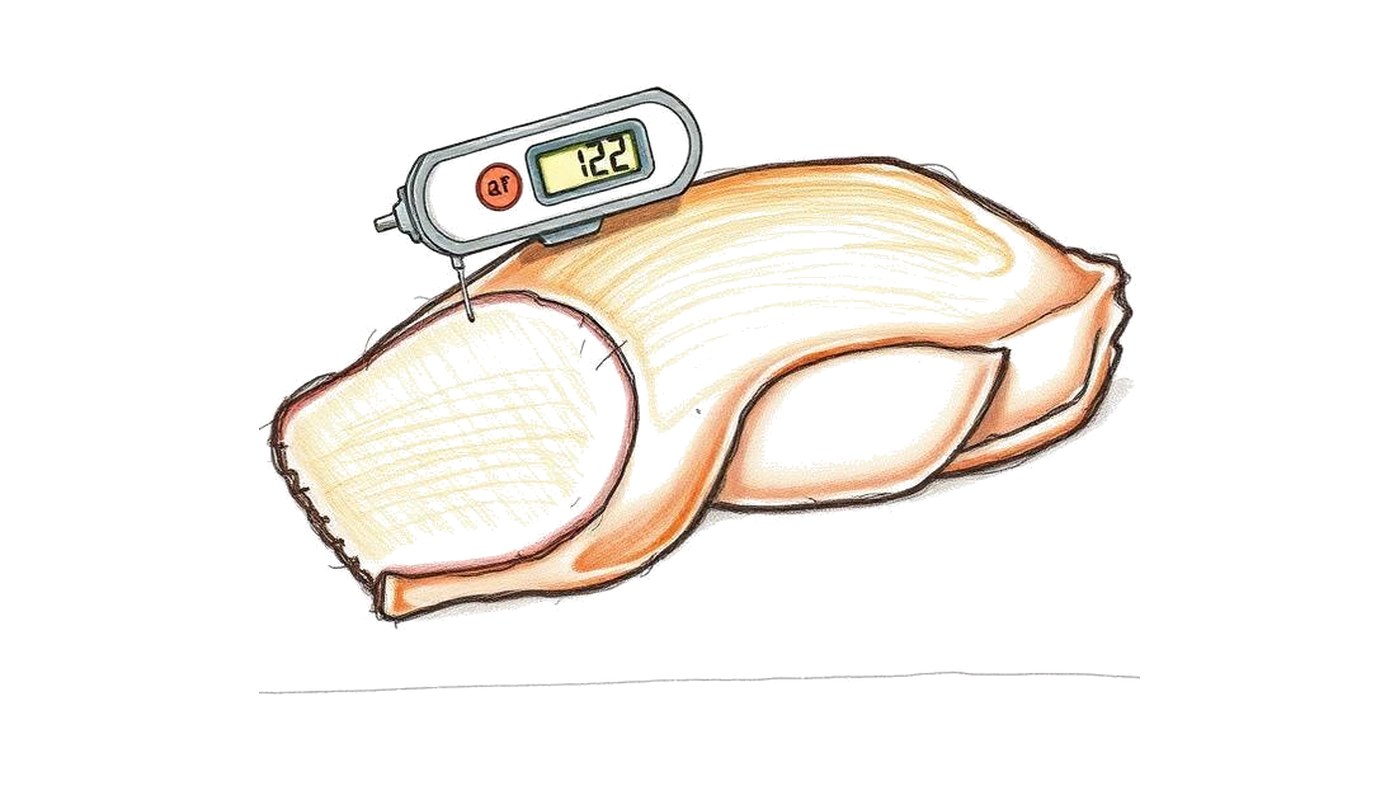
Insert the probe horizontally through the thickest part of the breast, parallel to the cutting board.
- Pull temperature
- A widely used culinary target is pulling at roughly 130–135°F (54–57°C) for a rosy centre.
- Carryover
- Carryover is significant on a rendered, skin-on breast — expect a 5–10°F (3–5°C) rise while resting.
- Rest
- 8–10 minutes, skin side up, before slicing.
- Texture check
- Centre should be a deep rose colour, warm, and yielding, not cool or translucent.
A hot, dry pan renders skin fat quickly and heats the breast from one side, so probe from the side, not through the top.
How this is calculated
Assumptions behind these numbers
- Pull temperatures
- The temperature to remove from heat, not the final temperature — carryover typically adds 2–5°F (1–3°C) during the rest.
- Where to measure
- The thickest part of the muscle, avoiding bone and fat, with a calibrated instant-read probe.
- Culinary versus USDA targets
- Medium-rare breast targets are a culinary convention below the USDA 165°F (73.9°C) poultry minimum, and are flagged as such in the results.
- Not modelled
- Thermometer calibration error, individual health risk factors, sous-vide time-at-temperature pasteurisation, or ground/mechanically tenderised duck.
Anyone at higher risk from foodborne illness — pregnancy, young children, older adults, weakened immunity — should use the well-done target and follow local food-safety guidance over any culinary convention.
How to read the result
Every combination returns four things: where to place the probe, a pull temperature, how much the meat will keep cooking after it comes off heat, and how long to rest it. Where the pull temperature sits below the USDA minimum, that is flagged explicitly as a culinary convention rather than a safety recommendation — the two are never blended into one number.
Texture cues are included alongside temperature because a single point reading can miss uneven cooking, especially on the grill or in a hot pan where surface heat is uneven.
Common questions
- Why is duck breast sometimes served below the official safe minimum?
- The official safe minimum for all poultry is 165°F (73.9°C). A widely used culinary convention cooks duck breast rosier than that for texture. That convention is a choice, not a safety endorsement.
- What is carryover cooking?
- Meat keeps cooking after it leaves the heat as residual warmth moves toward the centre. A well-rendered duck breast can rise 5–10°F (3–5°C) during rest.
- Do legs need a thermometer if I'm going by texture?
- A thermometer still helps confirm you're in a safe and tender range, but legs are unusually forgiving — texture is a reliable secondary check.
References
- Safe Minimum Internal Temperature Chart — USDA Food Safety and Inspection ServiceAll poultry, including duck and duck pieces, is listed at a 165°F (73.9°C) safe minimum internal temperature.Reference checked 2026-08
- Duck and Goose from Farm to Table — USDA Food Safety and Inspection ServiceHandling, labelling, storage and cooking guidance specific to duck and goose.Reference checked 2026-08