
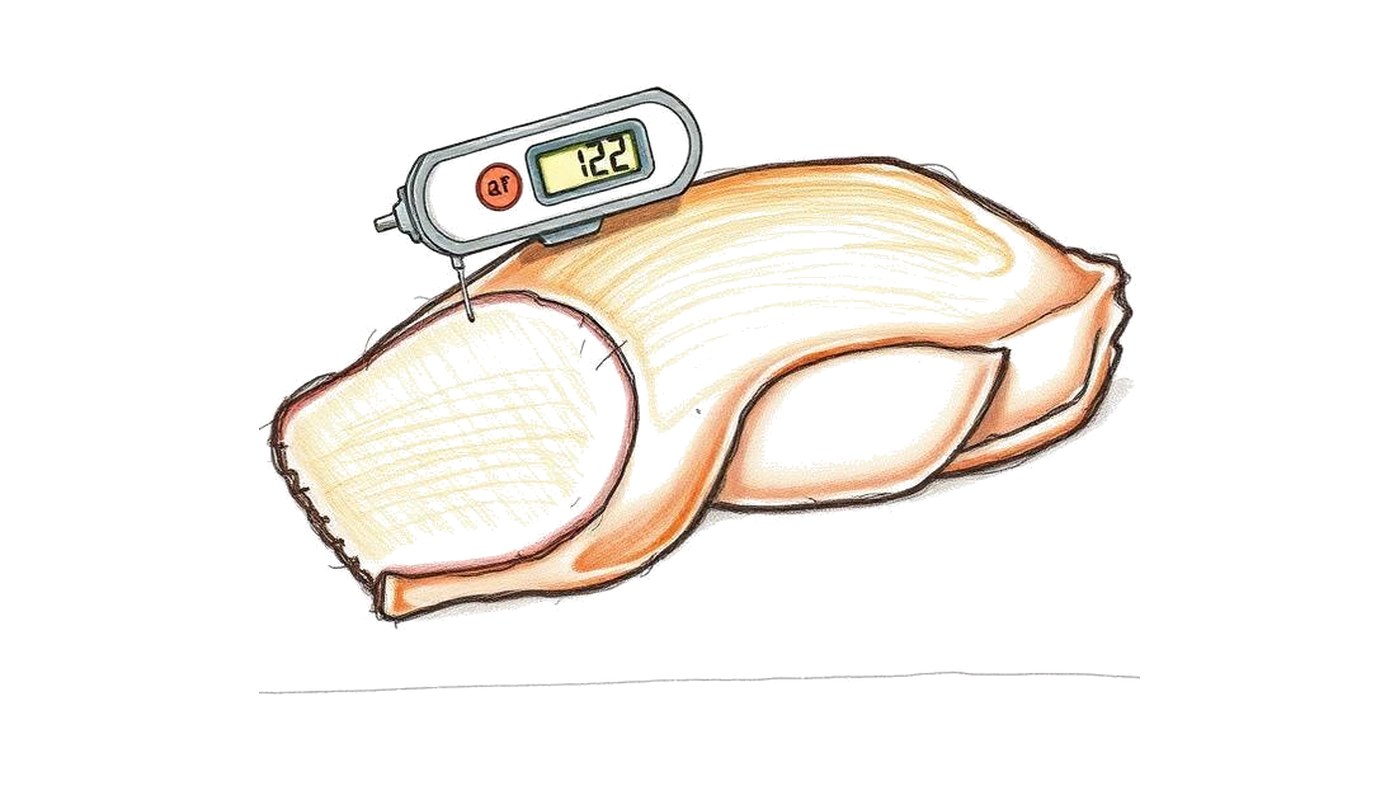
The right thermometer for duck depends less on brand and more on what you're cooking. A breast that finishes in a few minutes needs a fast spot-check tool. A whole roast or a long confit needs something that can watch the oven while you're not standing over it. Buying the wrong category for your cooking style is the most common mistake here — not buying a "bad" unit.
Updated
The short answer
- You mostly cook duck breast
- Fast, thin-tipped instant-readThe doneness window on a breast is measured in seconds, and a thin tip doesn't drain the muscle you just cooked.
- You roast whole ducks
- Leave-in probe with an alarmIt watches a two-hour cook without you opening the oven, which is what actually costs you heat.
- You cook confit or other long, low cooks
- Leave-in probe, or a thermometer rated for the oil temperature you holdYou're holding a stable low temperature for hours, so continuous monitoring beats repeated spot-checks.
- You want one tool for everything
- Instant-read, plus an oven thermometer if you suspect your oven liesAn instant-read covers every cut; an ambient reading explains cooking times that don't match the recipe.
How we made these calls
We compare thermometer types against the three duck cooks that actually stress them — a breast that passes its window in seconds, a whole bird that runs for hours, and a low, slow confit — and describe the specifications that decide each case.
What this is based on
- Published manufacturer specifications for the categories described: stated read time, probe dimensions, temperature range, stated accuracy, and water-resistance rating.
- The temperature targets and probe placement on our own duck doneness and cooking-time pages.
- Standard verification practice any cook can run at home: an ice-bath check and a boiling-water check.
Evaluation basis. Published manufacturer specifications for each category — stated read time, probe dimensions, temperature range, stated accuracy, and water resistance — read against the temperature targets on our doneness and cooking-time pages.
Match the thermometer to how you cook
Start from your cooking profile, not a shopping list. Most home cooks fall into one of three patterns, and each rewards a different tool.
| Cook profile | Best tool | Why |
|---|---|---|
| Breast-first cook | Fast instant-read | You're checking a thin cut inside a window measured in seconds; you need to be there and read it fast. |
| Whole-roast cook | Leave-in probe with alarm, or instant-read for a final check | A two-hour roast benefits from continuous monitoring; a final instant-read spot-check confirms the read before carving. |
| Confit / long, low cook | Leave-in probe, or scheduled spot-checks | The cook runs for hours at low, stable heat — continuous monitoring saves you from opening the oven repeatedly. |
See duck breast temperature and doneness and whole duck cooking time for the actual target numbers behind each profile.
What actually matters on a spec sheet
Once you know your category, these are the specifics worth reading before you buy — without assuming any particular brand or model has the best version of them.
Read speed
On a breast, a thermometer that takes ten or more seconds to settle can cost you real overcooking while you wait for a stable number. Look for a stated read time in the low single digits of seconds on any instant-read you're considering.
Tip diameter
A thin probe tip matters most on duck breast: a fat tip tears muscle fibres and lets juice run out through the hole it made, which is the opposite of what you want right before resting and slicing. Leave-in probes are generally thicker by design — fine for a thigh or a whole bird, clumsy on a breast.
Probe placement ergonomics
On a whole bird, you're aiming for the thickest part of the thigh without touching bone — a task that's much easier with a probe that has some stiffness and a clear depth marker or guard, rather than a floppy, unmarked wire.

Ambient oven probes
Some leave-in models include a second probe or a display mode that reads the oven's actual air temperature, not just the dial setting. This is worth having if you suspect your oven runs hot or cold — a common and largely invisible source of the "why did this take longer than the recipe said" problem covered in whole duck cooking time.
Calibration, water resistance, and warranty
Check whether a model supports user calibration (useful after it's been dropped), what water-resistance rating it carries if you plan to rinse it under a tap, and the length and terms of the warranty — probes and cables are usually the first thing to fail. Treat all three as spec-sheet items to compare, not as claims we're making about any specific product.
Common mistakes
- Buying a leave-in probe for someone who only ever cooks duck breast.
- Trusting a reading taken near bone, which reads differently from the surrounding meat.
- Never checking calibration after the unit has been dropped or left in a hot dishwasher.
- Reading immediately on insertion instead of waiting the stated settling time.
Which one should you buy
Choose a fast instant-read if: you mostly cook duck breast, or you want one general-purpose tool that also works for other proteins.
Choose a leave-in probe if: you roast whole ducks regularly, or you cook confit and want to avoid opening the oven every twenty minutes.
Choose both if: you do a genuine mix of both cooking styles — a leave-in probe for the long cook, an instant-read for the final check before carving or slicing.
For the actual target numbers and probe placement to use with whichever tool you choose, run through the interactive duck doneness guide.
The decision matrix
Four categories, and the specification that decides each one. Nothing here is a ranking — the rows are the questions to ask, not scores.
| Specification | Instant-read | Leave-in probe | Oven / ambient | Infrared surface |
|---|---|---|---|---|
| What it answers | Internal temperature, right now | Internal temperature, continuously | The oven's real air temperature | Surface temperature of a pan or skin |
| Speed | Look for a stated read time in low single-digit seconds | Continuous, so speed is not the constraint | Slow by design — it tracks a settled environment | Effectively instant |
| Probe geometry | Thin tip; the thinner the better on a breast | Thicker, cabled or wireless; built to stay put | No probe — it hangs or stands in the oven | No probe at all |
| Accuracy check | Ice-bath and boiling-water checks; some models allow user calibration | Same checks; verify each probe separately | Compare against a known-good probe | Hard to verify at home; treat readings as approximate |
| Temperature range to look for | Covers fridge-cold through hot-pan territory | Check the probe and cable ratings separately from the display | Covers the full oven range you actually use | Check the stated range covers searing temperatures |
| Waterproofing and cleaning | Check the stated rating before rinsing under a tap | Cables are usually the weak point; wipe rather than submerge | Wipe only | Wipe only |
| Duck cook it suits | Breast; final check before carving a whole bird | Whole roast; confit | Diagnosing whole-roast timing | Pre-heating a pan for the sear |
Who each option is for
Listed in no particular order. We don't rank these, because the right answer changes with how you cook rather than with any score we could assign.
Fast instant-read
Good fit: Breast-first cooks, and anyone who wants one thermometer for all proteins.
Not for: Long unattended roasts — you have to be standing there to use it.
Leave-in probe with alarm
Good fit: Whole-duck roasters and confit cooks who want to stop opening the oven door.
Not for: Duck breast, where the probe is usually too thick for a thin cut.
Oven / ambient thermometer
Good fit: Anyone whose roasts consistently take longer or shorter than the recipe says.
Not for: Reading the meat — it tells you about the oven, not the duck.
Infrared surface thermometer
Good fit: Checking pan surface temperature before the breast goes in.
Not for: Doneness of any kind. It reads a surface, never an internal temperature.
Compare instant-read, leave-in, and a brand candidate
| Option | Primary use | Read speed | Probe tip | Oven monitoring | Calibration & care |
|---|---|---|---|---|---|
| Fast instant-read thermometer | Spot-checks: you open, probe, read, and decide within a few seconds. | Look for a stated read time in the low single-digit seconds. | A thin tip matters most on breast — a fat probe tears the fibres and leaks juice. | None. You have to be at the pan. | Check against an ice bath (32°F/0°C); some models offer user calibration. |
| Leave-in probe with alarm | Probe stays in the bird; the display or app tells you when to act. | Less relevant — it tracks continuously rather than sampling. | Thicker than an instant-read; fine for a thigh, clumsy on a breast. | Its whole reason to exist. Many models also read ambient oven temperature. | Cable and probe are the wear points; check the warranty terms. |
| ThermoWorks | Sells both instant-read and leave-in probe styles. | Publishes read-speed and accuracy specifications per model. | Several models use a thin tip suited to breast. | Leave-in and multi-channel models are available. | Documents calibration options and water-resistance ratings per model. |
Fast instant-read thermometer
Best for: Duck breast, and anyone who cooks breast more often than whole birds.
- Primary use
- Spot-checks: you open, probe, read, and decide within a few seconds.
- Read speed
- Look for a stated read time in the low single-digit seconds.
- Probe tip
- A thin tip matters most on breast — a fat probe tears the fibres and leaks juice.
- Oven monitoring
- None. You have to be at the pan.
- Calibration & care
- Check against an ice bath (32°F/0°C); some models offer user calibration.
Why it stands out
- The only practical tool for a breast that passes through its window in under a minute.
- Also useful for confirming rested temperature before slicing.
What to check
- No alarm, no unattended cooking.
- You lose oven heat every time you check a roast.
No verified seller link yet
Details checked 2026-08
Leave-in probe with alarm
Best for: Whole roast duck, confit, and long low-temperature cooks.
- Primary use
- Probe stays in the bird; the display or app tells you when to act.
- Read speed
- Less relevant — it tracks continuously rather than sampling.
- Probe tip
- Thicker than an instant-read; fine for a thigh, clumsy on a breast.
- Oven monitoring
- Its whole reason to exist. Many models also read ambient oven temperature.
- Calibration & care
- Cable and probe are the wear points; check the warranty terms.
Why it stands out
- Removes the guesswork from a two-hour roast without opening the oven.
- Ambient-probe models expose how far your oven drifts from its dial.
What to check
- Not a substitute for a fast spot-check at the moment of truth.
- Cables and probes fail before displays do.
No verified seller link yet
Details checked 2026-08
ThermoWorks
Best for: Cooks who want a documented accuracy spec rather than an unlabelled generic probe.
- Primary use
- Sells both instant-read and leave-in probe styles.
- Read speed
- Publishes read-speed and accuracy specifications per model.
- Probe tip
- Several models use a thin tip suited to breast.
- Oven monitoring
- Leave-in and multi-channel models are available.
- Calibration & care
- Documents calibration options and water-resistance ratings per model.
Why it stands out
- Per-model specifications are published, so you can compare rather than guess.
- Covers both thermometer categories duck cooking needs.
What to check
- Priced above generic probes; verify the current spec sheet for the exact model.
- A shortlist built from published specifications — compare the current spec sheet before choosing.
Included because it publishes relevant per-model specifications you can compare.
Details checked 2026-08
Evaluation basis: published specifications, manufacturer or seller documentation, and the duck-specific cooking requirements explained in this guide. Editorial standards
Shop this guide
What this guide actually asks you to own. If you already have a working version, keep it.
A fast instant-read thermometer
The minimum tool for cooking duck breast to a repeatable result.
See target temperaturesA leave-in probe with alarm
Worth adding once whole roasts or confit become a regular part of your cooking.
See cooking-time ranges
Cooking duck tonight? Don't guess.
If you want skin that shatters and a breast you can call at the right temperature, the playbook is the short version: scoring depth, cold-pan rendering, and the numbers to pull at. Tell us what you're cooking in the Duck Game Plan and we'll build your temperature, timing, crispy-skin and serving plan. Subscribers also get Duck the Fundamentals, the printable 28-page playbook, a short welcome series, and occasional DeliciousDuck recipes and guides.
- Scoring depth and cold-pan rendering, step by step
- Pull temperatures and carryover for breast, with a rest plan
- Why skin turns leathery, and the two fixes that work
- A printable kitchen card with temperatures and timings
You can also read our companion article, the Duck Cooking Starter Guide, plus the temperature and doneness guide and the calculators, right now.
Common questions
- Do I really need a thermometer for duck breast?
- You don't strictly need one, but duck breast passes through its target window in well under a minute once it's near done. A thermometer removes the guesswork that otherwise costs you an overcooked breast.
- Can I use the same thermometer for a whole duck and a breast?
- An instant-read will work on both, but a thin-tipped model is far better on a breast, where a fat probe tears the muscle fibres and lets juice escape.
- How do I check a thermometer's accuracy?
- Ice-bath test: a slurry of ice and water should read 32°F (0°C). Boiling-water test at sea level should read 212°F (100°C), adjusted for altitude. If a unit is off by more than a couple of degrees, calibrate it if the model allows, or account for the offset.
- Is a leave-in probe more accurate than an instant-read?
- Accuracy depends on the specific unit, not the category. What differs is what each is built for: continuous monitoring versus a fast spot-check.
Related guides
- Duck Breast Temperature & DonenessWhat the numbers mean, and where safety guidance and kitchen practice differ.
- Interactive Duck Doneness GuideTargets, probe placement and carryover by cut and method.
- Whole Duck Cooking TimePlan by weight, finish by thermometer — and why the two never fully agree.
- How to Cook Duck BreastThe cold-pan method, why it works, and how to rescue it when it doesn't.
- Best Pan for Duck BreastThermal mass versus control, and which one your method needs.
- Duck Cooking-Time PlannerA planning range for a whole duck by weight and oven temperature.
- Where to Buy Duck Breast OnlineFormats, weights and arrival checks — then the seller that fits your cook.
- Where to Buy Duck OnlineEight things to compare before you pay for cold-chain shipping.
- Best Roasting Pan for DuckA rack, room for the fat, and a measured fit — the rest is preference.
- Oven-Roasted Duck BreastDuck breast rendered in a skillet and finished in the oven — the steadier route to crisp skin and an even rosy centre when you are cooking four or more.