
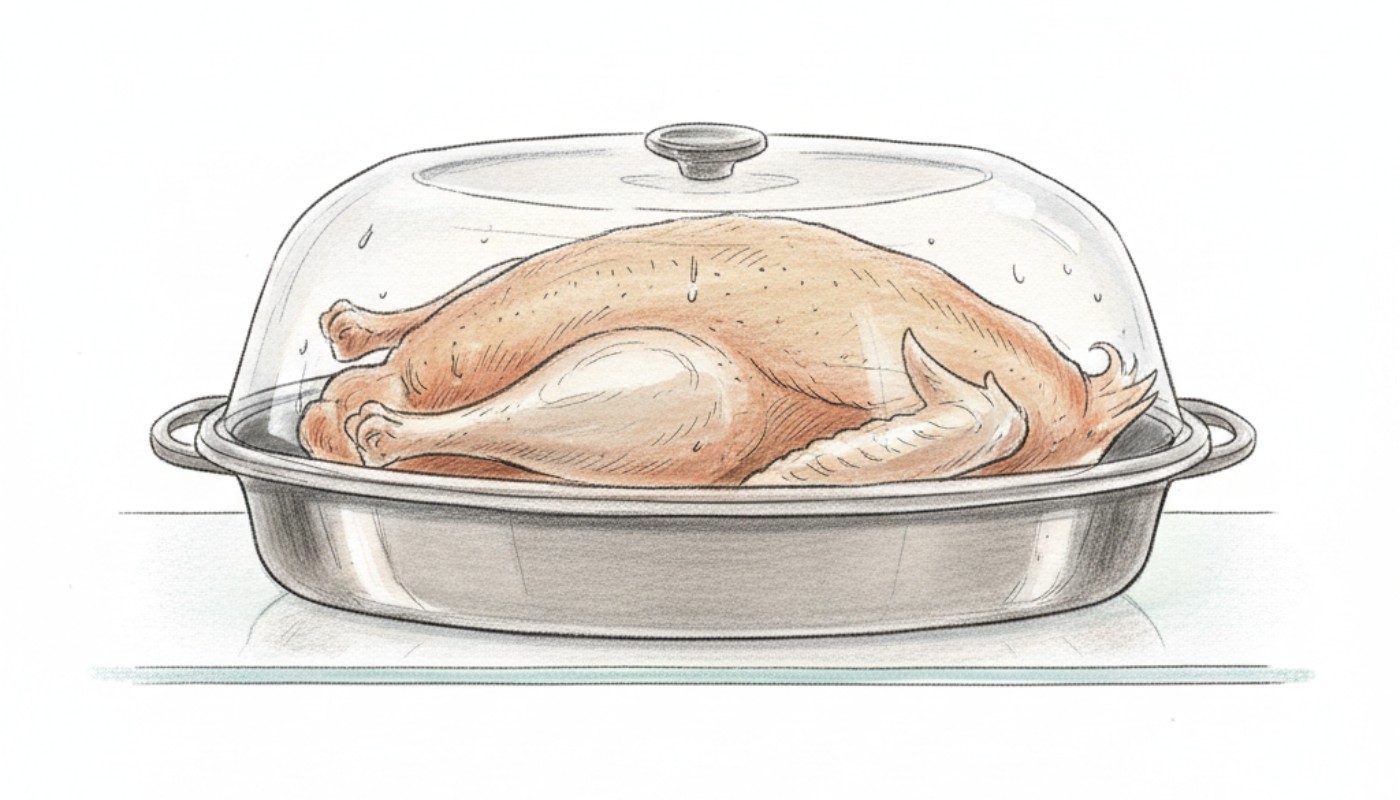
Short answer
Thaw a whole duck in the refrigerator, allowing roughly 24 hours per 4–5 lb (2–2.5 kg), on a tray on the bottom shelf. For a faster thaw, submerge the sealed bird in cold water and change the water every 30 minutes, then cook it the same day. Never thaw duck on the counter.
Refrigerator-first: the default method
Thaw in the refrigerator, at or below 40°F (4.4°C). It is the recommended method because the duck never leaves the safe range while it thaws.† The trade-off is time — a whole bird needs a full day or more depending on its weight. Plan backward from your cooking date rather than discovering the duck is still icy the morning you meant to roast it.
| Item | Weight | Refrigerator thaw time |
|---|---|---|
| Whole duck | 1.8–2.0 kg (4–4.5 lb) | 24–36 hours |
| Whole duck | 2.3–2.7 kg (5–6 lb) | 36–48 hours |
| Whole duck | 2.9–3.2 kg (6.5–7 lb) | 48–60 hours |
| Duck breasts | 170–225 g (6–8 oz) each | 12–24 hours |
| Duck legs | 225–340 g (8–12 oz) each | 18–24 hours |
Keep the duck in its original wrapping and set it on a rimmed tray or plate on the lowest fridge shelf so any drip cannot reach or drop onto other food. Once thawed, a whole duck keeps safely in the refrigerator for an additional 1–2 days before cooking; treat that window as a buffer, not a target.
Cold-water method, done correctly
If you're thawing faster than the fridge allows, cold water works, but only inside a fully sealed leak-proof bag or its original airtight packaging — submerging duck directly in water lets bacteria in and washes flavour and texture out. Submerge the sealed bird in cold tap water and change the water every 30 minutes to keep it cold as it draws heat from the duck. A whole duck typically thaws this way in 3–6 hours depending on weight; breasts and legs take under an hour. The critical rule: anything thawed in cold water must be cooked immediately afterward, not returned to the fridge for later.
Microwave thawing caveats
A microwave's defrost setting can thaw duck pieces quickly, but it thaws unevenly and often begins cooking the edges before the centre is thawed — which is why it is a last resort, and a poor one for a whole bird.† If you do use it, cook the duck immediately afterward — never let microwave-thawed poultry sit before cooking.
What never to do
- Never thaw on the counter. Room temperature lets the outer layers of the duck sit in the 40–140°F (4–60°C) danger zone for hours before the centre is even thawed.
- Never thaw in hot water. It speeds surface warming into unsafe territory long before the inside catches up.
- Never thaw in a warm garage, porch or car. These spaces are rarely a controlled cold temperature and vary with the weather outside.
Refreezing rules
Duck thawed in the refrigerator can be safely refrozen raw, though texture suffers a little with each freeze-thaw cycle. Duck thawed by the cold-water or microwave method must be cooked before it is refrozen, since those methods bring parts of the bird into the danger-zone temperature range and refreezing raw afterward is not considered safe.
How long thawed duck keeps
Once fully thawed in the refrigerator, raw duck keeps for 1–2 days before it should be cooked. Cooked duck, once cooled and refrigerated, keeps for 3–4 days. If you won't cook a thawed bird within that window, it's safer to cook and then refrigerate or freeze the cooked meat than to hold it raw any longer.
If the duck is arriving by post
A mail-order bird makes the thaw a scheduling problem rather than a same-day one, because the delivery date is not the cooking date. Build the calendar backward: cooking date, minus the refrigerator thaw time above, minus the seller's stated transit window, minus one buffer day for a courier that runs late. That last date is when you order.
Do not start counting thaw time from the moment the box arrives — count from the moment the bird is actually in your refrigerator at 40°F (4.4°C) or below. For what to check on arrival before any of this applies, see fresh versus frozen duck, which covers receiving a cold-chain delivery.
Thawing for a holiday is the one case where the date matters more than the method — the delivery date, the thaw days and the roast hour all have to agree. The dated version of that is our Thanksgiving duck dinner plan
Common questions
- Can I cook a duck from frozen?
- It's possible in an oven with roughly 50% more time, but uneven cooking and difficulty verifying internal temperature make it a poor default — thaw first whenever you can plan ahead.
- Is a little pink ice inside the cavity a problem after thawing?
- Small ice remnants near the cavity are common on a large bird and aren't a safety issue as long as the rest of the duck has thawed under refrigeration; give it more time before cooking.
- Does thawing in the wrapper versus unwrapped matter?
- Keep it wrapped. The packaging contains drip and limits surface exposure until you're ready to season and cook.
References
- The Big Thaw — Safe Defrosting Methods — USDA Food Safety and Inspection ServiceRefrigerator, cold-water and microwave thawing are the three methods considered safe; room-temperature thawing is not.Reference checked 2026-08
- Danger Zone (40°F – 140°F) — USDA Food Safety and Inspection ServicePerishable food should not sit between 40°F and 140°F for more than two hours.Reference checked 2026-08
- Duck and Goose from Farm to Table — USDA Food Safety and Inspection ServiceHandling, labelling, storage and cooking guidance specific to duck and goose.Reference checked 2026-08
Related guides
- Whole Roast DuckThe full workflow, from dry-fridge prep to a rested, carvable bird.
- Whole Duck Cooking TimePlan by weight, finish by thermometer — and why the two never fully agree.
- Fresh vs Frozen DuckFrozen isn't a downgrade — it's a scheduling decision.
- Where to Buy Duck OnlineEight things to compare before you pay for cold-chain shipping.
- Roasted Whole DuckA two-stage roast that renders the fat cap, keeps the breast juicy, and gets the legs fully tender.
- Duck vs. Turkey for ThanksgivingThe verdict up front, then the tradeoffs nobody mentions until the oven is full.
- Thanksgiving Duck Dinner PlanChoose your table, then order date, thaw date, oven schedule and menu — with a printable checklist.