
Short answer
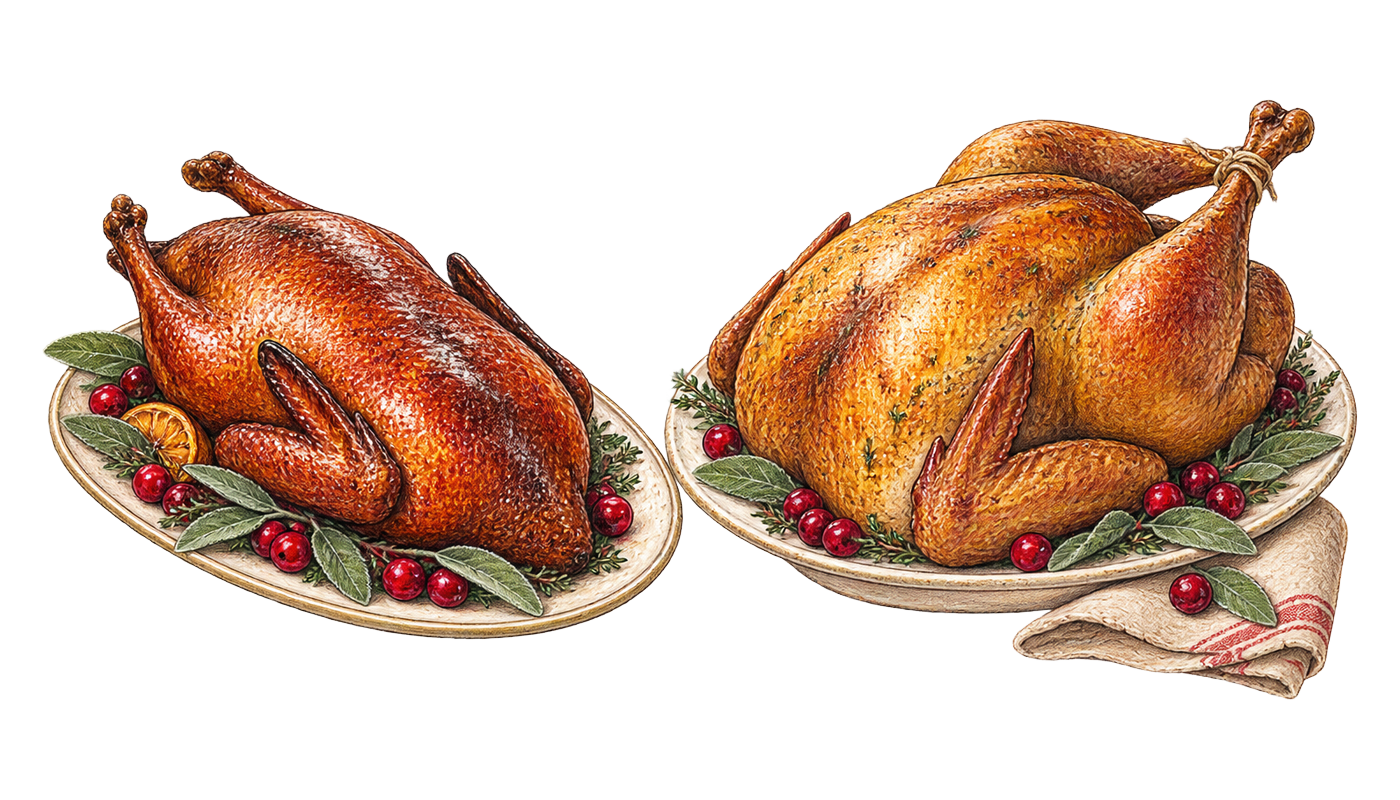
Duck suits a Thanksgiving table of two to six: it roasts in about half the time of a turkey, all the meat is dark and moist, and it renders fat you can cook the rest of the meal in. Turkey still wins on sheer volume — above roughly eight guests you need two ducks or a second oven.
Updated
The verdict, before the detail
Start by dropping the word “substitute”. A duck does not do a turkey's job in a smaller package: it is a darker, richer, fattier bird that changes the sauce, the sides and the shape of the meal around it. Treat it as its own centrepiece and it is a genuinely good holiday dinner. Treat it as a turkey stand-in and you will spend the day comparing it with something it was never trying to be.
The practical difference is how they scale. Turkey scales by weight: bigger table, heavier bird, and an official allowance from USDA of 1 lb of turkey per person to shop with.† Duck scales by count. It carries less edible meat for its weight and has no equivalent published allowance, so a bigger table means another bird — another share of the rack, another pan, another place for fat to go.
There is also a middle route that we like more than either extreme: keep a turkey as the anchor if the crowd came for the ritual, and add duck as a portioned course — seared breast or made-ahead legs — rather than a second whole bird. It is the version of this decision that upsets the fewest people.
Made the call? Start here
Going with duck
Settle the number of birds first, then follow the holiday roast through from dry skin to carving.
Larger or mixed table
Turkey stays the practical centrepiece when the table is big or the guests came for the ritual — duck can still join it as a second bird or a portioned cut.
Side by side, honestly
| Factor | Duck | Turkey |
|---|---|---|
| Flavour | Dark, rich, faintly gamey; closer to red meat than to chicken. Stands up to fruit, acid and warm spice. | Mild and neutral. Carries gravy, brine and stuffing rather than competing with them. |
| Texture | Two textures in one bird: firm breast meat and soft, silky leg meat, under skin that can be genuinely crisp. | Uniform and lean, with breast and leg finishing at different moments — the classic dry-breast problem. |
| Serving yield | Lower. More fat and frame relative to edible meat, so plan the count with our serving calculator rather than by bird size. | Higher, and easier to shop for: the official allowance is a pound of turkey per person, so one large bird covers a big table. |
| Oven and logistics | Sheds a great deal of fat that must be drained or managed; wants dry skin and a rack. Rewards attention. | Long, mostly unattended roast, but occupies the oven for hours and dominates the schedule. |
| Cost and availability | Often a speciality order, frequently frozen and shipped. We publish no prices — check your own sellers. | Widely stocked in season. Again, we publish no prices. |
| Leftovers | Fewer, plus two by-products: rendered fat and a carcass for stock. | Plenty, and they carry well into sandwiches, soup and hash. |
| Guest familiarity | Unexpected. Delightful to most, a hard no for a few — ask first if the group is fixed on tradition. | Expected. Nobody has to be talked into it. |
| Who should choose it | Small tables, confident cooks, anyone who cares more about the eating than the volume. | Large tables, first-time hosts, and anyone cooking for guests who came for the ritual. |
Serving capacity is the decision, not the flavour
Most duck Thanksgivings go wrong at the shopping stage. A whole duck looks like a small turkey and behaves like a large chicken with a fat layer: the frame is heavy and the fat cap is substantial, so a duck simply carries less edible meat than a turkey that weighs about the same. Buy for the meat you will actually carve, not for the number on the label.
Turkey has an official number to lean on: 1 lb of turkey per person, from USDA's consumer guide.† Duck has no published equivalent, and we are not going to invent one. Put your guest count and appetite into the whole-duck serving calculatorinstead: it states the planning assumptions behind its answer and returns the number of birds and the raw weight to order. If you are weighing a whole bird against portioned cuts, our how much duck per person guide sets the same assumptions out in prose. Both are our planning estimates, not established fact.
Oven time, and the space each bird needs
Here is what each bird asks of your afternoon. These are planning numbers, not doneness rules: either bird is done when a thermometer reads 165°F (73.9°C) in the thickest part of the meat, away from bone.†
| Bird | Oven | Approximate range |
|---|---|---|
| Whole duckling, 4 to 6 lb | 350°F | Approximately 30 to 35 min/lb. Do not stuff a whole duckling. |
| Unstuffed turkey, 8 to 12 pounds | 325°F or higher | Approximately 2¾ to 3 hours. |
| Unstuffed turkey, 20 to 24 pounds | 325°F or higher | Approximately 4½ to 5 hours. |
Read across the rows and the real difference shows up: scaling a turkey costs time in the same pan, while scaling a duck dinner costs hardware. Before you promise duck to a big table, measure your rack and count the roasting pans you actually own.
Timing references
- Duck and Goose from Farm to Table — USDA Food Safety and Inspection ServiceHandling, labelling, storage and cooking guidance specific to duck and goose.Reference checked 2026-08
- Let's Talk Turkey — A Consumer Guide to Safely Roasting a Turkey — USDA Food Safety and Inspection ServiceUSDA's consumer guide for turkey: the 1 lb per person planning allowance, refrigerator thawing at roughly 24 hours per 4 to 5 lb, the 165°F minimum internal temperature, and a 20-minute stand before carving. Use it for turkey-specific figures rather than any of our own.Reference checked 2026-08
Why our roast runs in two stages
The range above assumes one oven temperature start to finish. Our own whole roast duck method runs in two: a gentler stretch to render the fat cap without setting the skin, then a hot finish to crisp it. That is a texture preference, a recipe method — not a safety alternative to the planning chart, which is right about what it measures.
Change the oven temperature partway and the clock stops matching the chart. Use the range to choose a serving time, then let the thermometer say when the bird comes out; our whole duck cooking time guide explains where weight-based planning and temperature-based doneness diverge.
Choosing duck changes the whole plate
Turkey is a canvas. It is mild enough that the gravy, the stuffing, the brine and the herbs carry the flavour, which is precisely why the classic Thanksgiving plate looks the way it does. Duck turns up already loud, and the sides have a different job: not more richness, but something to cut it.
This is editorial pairing guidance rather than food-safety advice. Reach for tart citrus, a vinegar-dressed vegetable, bitter or peppery greens, a briny or savoury condiment on the side, and keep any sweetness restrained so the plate does not tip into dessert. Then use the bird twice: the fat you pour off mid-roast is the best thing that can happen to a tray of potatoes. Start with our acid pairing guide, duck sauces and what to serve with duck. These guides offer practical combinations for building the rest of the plate. A gravy-and-stuffing spread can still work around a duck, but it will read as two competing dinners unless something sharp lands on the plate.
Duck can feel every bit as celebratory as turkey without imitating the turkey plate. Design the meal around the bird you chose — a smaller centrepiece, brighter sides, potatoes cooked in duck fat — and nobody spends the afternoon looking for the gravy boat.
Culinary reading
- Chefs on cooking something other than turkey — Food & WineCulinary reading, not safety guidance: chefs discussing duck as a festive centrepiece, and the menu logic that suits it — citrus, vinegar-dressed vegetables, savoury condiments, and rendered duck fat used elsewhere in the meal.Reference checked 2026-08
- Crisp Roast Duck — EpicuriousCulinary reading, not safety guidance: a whole-duck roast written for cooks already comfortable roasting poultry, with the fat-rendering and skin management that a holiday duck asks for.Reference checked 2026-08
Two holiday sides that carry a duck dinner
If you build only two things around the bird, build these. Between them they use the fat the duck gives you and supply the sharpness it needs, which is most of what a duck menu asks for.
- Duck-fat roast potatoes. Pour the clear rendered fat off the pan mid-roast, parboil floury potatoes until the edges just turn fluffy, rough them up in the colander, then roast them hard in that fat until the crust shatters. Salt at the end. It is the one side guests remember, and it costs you nothing but the fat you already collected — see how to render duck fat and more ways to use it.
- Vinegar-forward greens. Bitter or peppery leaves — chicory, kale, escarole, shredded sprouts — wilted briefly or served raw, dressed while still warm with a dressing that leans further into acid than you normally would. Sherry or cider vinegar, a little mustard, restrained oil. Against rich duck a polite vinaigrette disappears, so make it bracing; our acid pairing guide covers which vinegars and citrus hold up.
Keep the rest of the table simple around them: something tart with fruit if you want a third dish, and one savoury or briny accent. For a fuller spread, what to serve with duck runs through the combinations we cook most often.
You do not have to roast a whole bird
A whole bird is the default holiday image, not a requirement. If the table is small, the oven is already full, or you simply do not want to manage a whole roast on the day, duck gives you two escapes a turkey does not offer as neatly.
- Duck breast, portioned. Cooked on the stovetop and finished to your preferred doneness, it frees the oven entirely and is served in slices rather than carved at the table. See how to cook duck breast and the pan-seared duck breast recipe.
- Legs, made ahead. Confit legs can be cooked days in advance and crisped while everything else rests, which turns the centrepiece into a reheating job on the day. See duck leg confit and the confit recipe.
- Or the whole bird anyway. If the presentation is the point, our roasted whole duck recipe is the version we cook.
Turkey has portioned routes too — a breast joint, or legs braised separately — so this is not a case of one bird being flexible and the other not. What differs is that duck's portioned cuts are the ones most home cooks are already comfortable buying and cooking.
Duck alongside turkey, or duck instead of turkey
Most hosts asking this question are really choosing between three plans, and the deciding factors are your kitchen and your guests rather than any number we could publish.
- Turkey, as the anchor. One oven, a large or tradition-minded crowd, and a menu already built around gravy and stuffing. Adding a duck here mostly costs you oven space you do not have.
- Duck, instead. A smaller or adventurous table, or more than one oven, plus a willingness to rethink the sides. This is where duck stops being a novelty and becomes the better dinner.
- Both, unevenly. A mixed table is best served by a turkey anchor plus duck breast or legs — not a second whole bird. You get the ritual and the interesting plate without doubling the roasting hardware.
Whichever plan you pick, settle the quantity before you shop: turkey against the per person allowance above, duck through the serving calculator and its stated assumptions.
What each bird does to your day
Turkey is a scheduling problem: it is large, it is slow, and it owns the oven. Duck is an attention problem: it needs its skin dried in advance, its fat drained during the roast, and a rest before carving. Neither is harder in the abstract — they simply demand different things from you.
- Thawing is calendar, not cooking. Three methods are considered safe — refrigerator, cold water and microwave — and the fridge needs approximately 24 hours of refrigerator thawing for every 4 to 5 lb of bird.† Our thawing guide has the weight-based times and the cold-water fallback.
- Dry skin beats any basting trick. An uncovered day in the refrigerator does more for duck skin than anything you can do in the oven. The full method is on our whole roast duck page.
- Plan for the fat. Rendered duck fat is a prize, not a mess, but it needs a heatproof container and a plan for when you pour it off mid-roast.
- Finish by thermometer, not by clock. Weight-based ranges are for planning only; see whole duck cooking time for the ranges and choosing a thermometer for the one tool this decision genuinely requires.
- Rest, then carve. Both birds carve better rested; a 20-minute stand before carving is the standard for a whole turkey, for quality rather than safety, and duck benefits from the same pause. Our carving guide takes it apart in the order that keeps the skin intact.
- Order early, then buffer. Holiday duck is usually a speciality order that ships frozen, so the seller's stated transit window is part of your timeline, not an afterthought. Add a spare day for a late delivery before you count backwards from the meal.
- Check the refrigerator, not just the oven. A thawing bird needs a tray on a low shelf for a day or more, and a duck you are drying wants to sit uncovered. Two ducks take up roughly twice that space, at exactly the time of year the refrigerator is fullest.
- Count your pans. Each bird needs a pan deep enough to hold the fat it renders and a rack that keeps it out of that fat. This is the practical ceiling on a duck holiday: hardware, not appetite.
Choose by constraint
If the comparison table did not settle it, work down your own constraints instead. This is our editorial read of the tradeoffs, not a scoring system.
| Constraint | Points to duck | Points to turkey |
|---|---|---|
| Guest familiarity | Guests who enjoy being surprised, or a table you cook for often enough to experiment with. | A fixed crowd that came for the tradition, or guests who would quietly mind the change. |
| Oven capacity | A second oven, or a table small enough for the birds and pans you already own. | One oven that also has to handle the sides — a single larger bird is the simpler occupant. |
| Desired leftovers | You would rather have a jar of rendered fat and a stock carcass than a stack of cold slices. | Sandwiches and soup for the rest of the week are part of the point of the holiday. |
| Menu richness | You are happy to build sides around acidity, tart fruit and bitter greens. | You want the classic gravy-and-stuffing spread to stay exactly as it is. |
| Presentation | A compact, restaurant-looking centrepiece, or elegant slices plated in the kitchen. | The big carve-at-the-table moment, which a heavier bird simply does better. |
| Cooking methods available | Stovetop searing or make-ahead confit can take the centrepiece off the oven entirely. | A long, mostly unattended roast fits a day where you cannot stand over the stove. |
The numbers worth being strict about
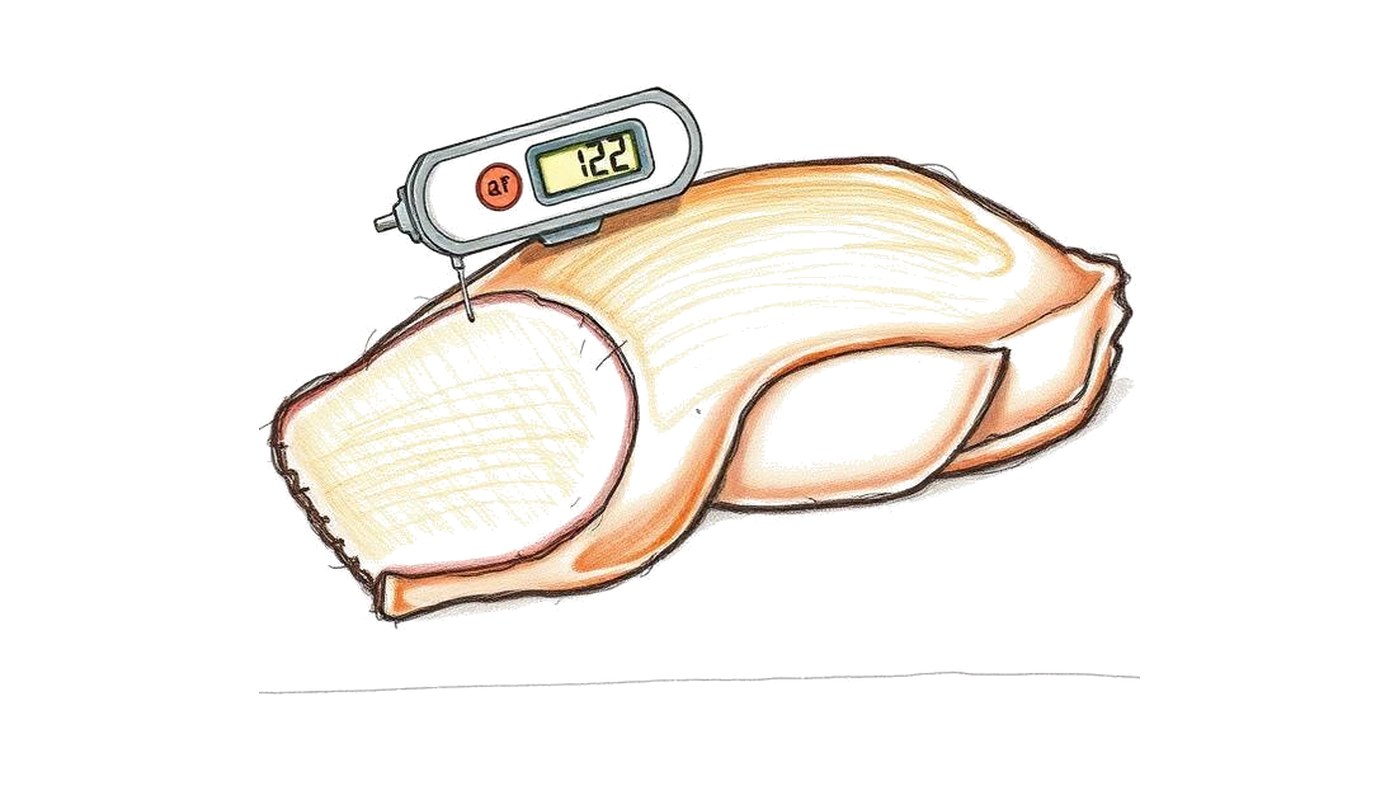
Species does not move the target. Whichever bird you roast, doneness is a thermometer reading in the thickest part of the meat, away from bone — never a colour or a clock.
Two more rules travel with any holiday meal. Perishable food should not sit between 40°F and 140°F (4.4°C and 60°C) for longer than two hours — one hour if the room is above 90°F (32.2°C). And cooked poultry keeps three to four days in the refrigerator, reheated to 165°F (73.9°C).
Safety references
- Safe Minimum Internal Temperature Chart — USDA Food Safety and Inspection ServiceAll poultry, including duck and duck pieces, is listed at a 165°F (73.9°C) safe minimum internal temperature.Reference checked 2026-08
- Duck and Goose from Farm to Table — USDA Food Safety and Inspection ServiceHandling, labelling, storage and cooking guidance specific to duck and goose.Reference checked 2026-08
- Let's Talk Turkey — A Consumer Guide to Safely Roasting a Turkey — USDA Food Safety and Inspection ServiceUSDA's consumer guide for turkey: the 1 lb per person planning allowance, refrigerator thawing at roughly 24 hours per 4 to 5 lb, the 165°F minimum internal temperature, and a 20-minute stand before carving. Use it for turkey-specific figures rather than any of our own.Reference checked 2026-08
- The Big Thaw — Safe Defrosting Methods — USDA Food Safety and Inspection ServiceRefrigerator, cold-water and microwave thawing are the three methods considered safe; room-temperature thawing is not.Reference checked 2026-08
- Danger Zone (40°F – 140°F) — USDA Food Safety and Inspection ServicePerishable food should not sit between 40°F and 140°F for more than two hours.Reference checked 2026-08
- Leftovers and Food Safety — USDA Food Safety and Inspection ServiceCooked poultry keeps 3–4 days refrigerated; reheat to 165°F.Reference checked 2026-08
- Stuffing and Food Safety — USDA Food Safety and Inspection ServiceUSDA recommends cooking stuffing separately for optimal safety and uniform doneness; if poultry is stuffed, the center of the stuffing must reach 165°F measured with a food thermometer.Reference checked 2026-08
Friday, and what you actually want on it
If leftovers are the point of the holiday for you, turkey wins on volume and that is not a close call. Duck answers differently: less cold meat, but shredded leg for a hash, a jar of fat that turns roast potatoes into the best thing on the table for a month, and a carcass worth simmering the same evening.
Refrigerate leftovers promptly instead of leaving the platter out through the evening. They keep three to four days, reheated to 165°F (73.9°C); freeze whatever you will not finish in that window.
The honest tradeoffs
Duck's weaknesses are real. Fewer plates per bird, an order placed in advance, a thaw on schedule, more of your attention during the roast — and a few guests who simply do not want a rich dark-meat centrepiece at this particular meal. Turkey's are just as real: a lean breast that punishes inattention, hours of oven occupation, and a flavour that depends almost entirely on what you put around it.
What we cannot tell you is which is cheaper or easier to find where you live. Duck pricing and holiday availability vary too much by region and season for us to publish a figure we have not verified, so treat cost as a question for your own sellers — our where to buy duck guide is a framework for judging them, not a price list.
If duck is the call, the planning is a separate job: order date, thaw schedule, a single-oven order of play, a printable checklist and a menu built against the richness. That all lives in our Thanksgiving duck dinner plan
What this page is based on
- USDA safe-handling guidance for poultry — thawing, the 165°F minimum internal temperature, danger-zone limits and leftover windows — which applies to duck and turkey alike.
- USDA's own consumer guide to roasting turkey, which we point readers at rather than publishing turkey timings of our own, including its approximate unstuffed-turkey roasting ranges at 325°F.
- USDA's duck and goose guidance, including its approximate planning range of 30 to 35 min/lb at 350°F for a 4 to 6 lb whole duckling, and USDA's stuffing guidance.
- Our own published planning assumptions, which live in the whole-duck serving calculator rather than in this page, plus the oven workflow documented on our whole-roast-duck and carving pages.
Evaluation basis. USDA temperature, thawing, and storage guidance for both birds, plus stated planning assumptions for serving numbers. Cost and availability vary by region and season, so check your own sellers.
Next steps
Settle the number of birds first, then the workflow, then the order date.
- Whole-duck serving calculator
The fastest way to settle the yield question: guest count in, number of birds and raw weight out.
- How to roast a whole duck
The full holiday workflow, from drying the skin to resting and carving the bird.
- Where to buy duck
Holiday duck usually ships frozen, so ordering early is part of the decision.
Common questions
- How many people does one duck feed at Thanksgiving?
- Fewer than a turkey of the same weight, because more of a duck is fat and frame. We will not put a fixed ratio on it: give your guest count to our whole-duck serving calculator, which shows the planning assumptions behind its answer and returns the number of birds and the raw weight to order. Turkey is the easier maths — the official allowance from USDA is 1 lb of turkey per person.
- Which takes longer in the oven, a whole duck or a whole turkey?
- The turkey, almost always, because it is a much heavier bird. For planning, a whole duckling of 4 to 6 lb sits at roughly 30 to 35 min/lb in a 350°F oven; an unstuffed turkey at 325°F runs approximately 2¾ to 3 hours at 8 to 12 pounds and approximately 4½ to 5 hours at 20 to 24 pounds. Use those to pick a serving time only. The bird is done at 165°F (73.9°C) on a thermometer, whatever the clock says.
- Can I cook duck and turkey in the same oven?
- You can, but not comfortably at the same time. Both birds want air around them, the two planning charts assume different oven settings, and a duck sheds a lot of fat that has to go somewhere. If you want both, time the duck so its 20-minute rest lands inside the turkey's last stretch of cooking or its own rest, and carve the duck last. If the two schedules will not meet there, use a second oven or serve portioned duck — breasts or confit legs — rather than leaving a whole cooked duck standing for a long wait.
- Does duck need a different internal temperature than turkey?
- No. All poultry, duck and turkey alike, has the same safe minimum internal temperature: 165°F (73.9°C), read with a thermometer in the thickest part of the meat and away from bone. The lower numbers you see quoted for duck breast are a culinary convention rather than a safety figure, and they are a separate question from a whole holiday bird.
- Is duck harder to carve than turkey?
- A different shape, not a harder job. A duck is narrower and its breast sits close to the frame, so you take the legs off at the joint and lift each breast off in one piece rather than carving broad slices off a standing bird. Our carving guide has the order that keeps the skin intact. Either bird carves better rested — a 20-minute stand is the standard advice for a whole turkey, and duck likes the same pause.
- Can you make gravy from duck drippings?
- Yes, but the drippings behave differently. Most of what collects in a duck pan is clear rendered fat, which you pour off and keep rather than thicken; the gravy comes from the smaller layer of browned juices underneath, loosened with stock or wine. A turkey pan gives you far more of that juice-to-fat ratio, which is why turkey gravy is the easier default. With duck we would build a sauce around acidity or tart fruit rather than chase a thick roux gravy.
- Can I stuff the cavity of a duck or a turkey?
- Cook it separately if you can. USDA recommends cooking stuffing separately, in a casserole, for optimal safety and more even doneness, and the duck planning chart says not to stuff a whole duckling at all. If you do stuff a bird, pack it loosely just before it goes in, and check that the center of the stuffing itself reaches 165°F (73.9°C) — not only the meat. Stuffing below that when the bird is done needs more cooking.
- Is duck harder to cook than turkey?
- Different, not harder. Duck is forgiving about moisture, because the fat layer bastes the meat as it renders, and demanding about logistics: score the skin, drain the fat as it collects, dry the skin a day ahead if you want it crisp. Turkey is the reverse — easy to manage, easy to overcook.
- Which gives better leftovers?
- Turkey gives more of them. Duck gives fewer but arguably better ones, plus two by-products a turkey does not: a jar of rendered fat for roast potatoes and a carcass that makes a deeply savoury stock. Either way, cooked poultry keeps three to four days in the refrigerator and is reheated to 165°F (73.9°C).
- When should I order a duck for Thanksgiving?
- Earlier than feels necessary. Holiday duck usually ships frozen, and thawing lands on your calendar rather than the seller's. Count backwards from the meal: allow approximately 24 hours of refrigerator thawing for every 4 to 5 lb of bird, then the transit window your seller quotes, then a spare day in case it slips.
References
- Safe Minimum Internal Temperature Chart — USDA Food Safety and Inspection ServiceAll poultry, including duck and duck pieces, is listed at a 165°F (73.9°C) safe minimum internal temperature.Reference checked 2026-08
- Duck and Goose from Farm to Table — USDA Food Safety and Inspection ServiceHandling, labelling, storage and cooking guidance specific to duck and goose.Reference checked 2026-08
- Let's Talk Turkey — A Consumer Guide to Safely Roasting a Turkey — USDA Food Safety and Inspection ServiceUSDA's consumer guide for turkey: the 1 lb per person planning allowance, refrigerator thawing at roughly 24 hours per 4 to 5 lb, the 165°F minimum internal temperature, and a 20-minute stand before carving. Use it for turkey-specific figures rather than any of our own.Reference checked 2026-08
- The Big Thaw — Safe Defrosting Methods — USDA Food Safety and Inspection ServiceRefrigerator, cold-water and microwave thawing are the three methods considered safe; room-temperature thawing is not.Reference checked 2026-08
- Danger Zone (40°F – 140°F) — USDA Food Safety and Inspection ServicePerishable food should not sit between 40°F and 140°F for more than two hours.Reference checked 2026-08
- Leftovers and Food Safety — USDA Food Safety and Inspection ServiceCooked poultry keeps 3–4 days refrigerated; reheat to 165°F.Reference checked 2026-08
- Stuffing and Food Safety — USDA Food Safety and Inspection ServiceUSDA recommends cooking stuffing separately for optimal safety and uniform doneness; if poultry is stuffed, the center of the stuffing must reach 165°F measured with a food thermometer.Reference checked 2026-08
Cooking duck tonight? Don't guess.
Roasting a whole duck is a timing problem before it is a cooking problem. The playbook carries the planning timeline, from thawing to resting. Tell us what you're cooking in the Duck Game Plan and we'll build your temperature, timing, crispy-skin and serving plan. Subscribers also get Duck the Fundamentals, the printable 28-page playbook, a short welcome series, and occasional DeliciousDuck recipes and guides.
- A planning timeline from thawing through carving
- Fat rendering and basting decisions for a whole bird
- Portioning guidance so you buy the right size
- A printable kitchen card with temperatures and timings
You can also read our companion article, the Duck Cooking Starter Guide, plus the temperature and doneness guide and the calculators, right now.
Related guides
- Whole Roast DuckThe full workflow, from dry-fridge prep to a rested, carvable bird.
- Whole-Duck Serving CalculatorTurn a guest count into how many birds to buy.
- Whole Duck Cooking TimePlan by weight, finish by thermometer — and why the two never fully agree.
- How to Thaw Duck SafelyFridge-first planning times, plus the cold-water fallback when you're late.
- Where to Buy Duck OnlineEight things to compare before you pay for cold-chain shipping.
- Best Thermometer for DuckInstant-read or leave-in? Match the tool to how you cook duck.
- Roasted Whole DuckA two-stage roast that renders the fat cap, keeps the breast juicy, and gets the legs fully tender.
- Thanksgiving Duck Dinner PlanChoose your table, then order date, thaw date, oven schedule and menu — with a printable checklist.