
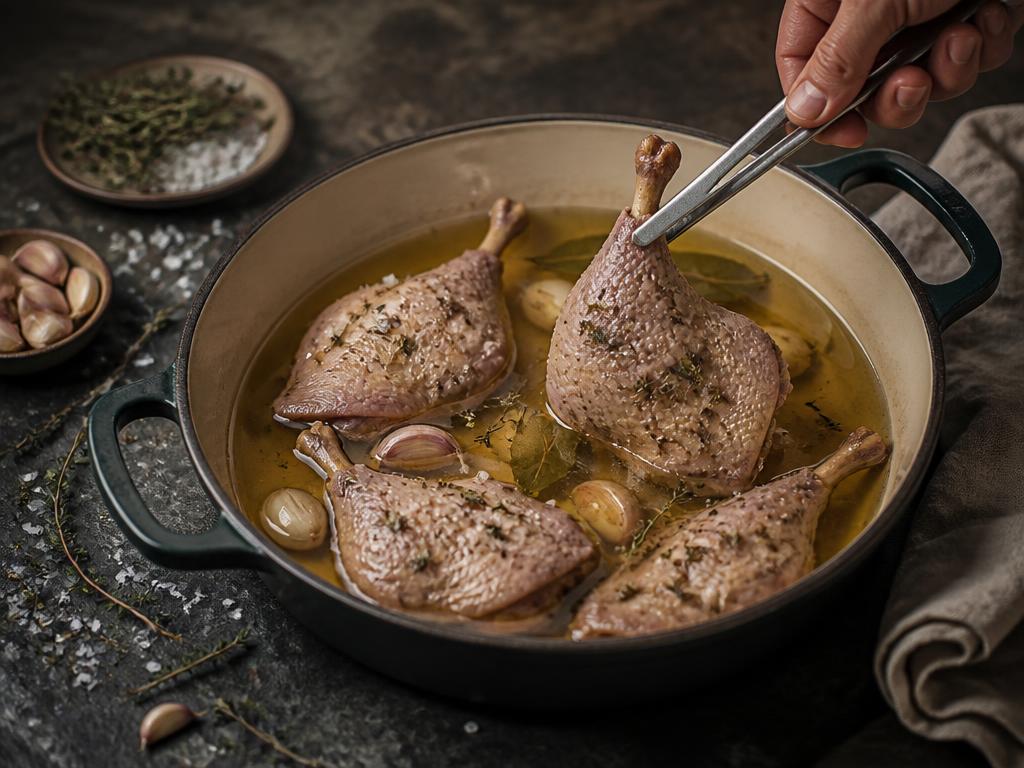
Method basis: established culinary technique and published food-safety guidance. Cook to the stated internal temperatures rather than to the clock. Editorial standards
Ingredients
Cure
- 4 duck leg quarters, about 1.2 kg (2.6 lb) total
- 18–24 g (1–1½ tbsp) coarse sea salt, roughly 1.5–2% of the leg weight
- 4 garlic cloves, crushed
- 6 sprigs thyme
- 2 bay leaves, torn
- 1 tsp cracked black pepper
Poach
- 1–1.5 L (4–6 cups) rendered duck fat, enough to submerge the legs
- Neutral oil to top up, if you are short on duck fat
Cooking for a different number? Scale the quantities rather than guessing — fat and salt do not scale linearly with guest count.
Equipment that matters
Snug, deep oven-safe pot
The narrower the vessel, the less fat you need to keep the legs fully covered.
Instant-read thermometer
Domestic ovens are least accurate at low settings — measure the fat, not the dial.
Before you start
Plan backwards from dinner
Cure overnight (12–24 hours), poach for 2.5–3.5 hours, then either serve immediately or cool and refrigerate under the fat for 3–4 days. The crisping step at the end takes 10–15 minutes.
Build a fat supply
Confit needs a lot of fat. Save the rendered fat from every duck breast and roast you cook — see the rendering guide — and top up with neutral oil if you are short. The legs must stay submerged, but they do not have to be submerged in duck fat alone.
Method, step by step
Cure the legs
Mix salt, garlic, thyme, bay and pepper. Rub over the legs, lay them skin-side up in a single layer, cover, and refrigerate 12–24 hours. Shorter gives lighter seasoning; longer gives a firmer, more intense result.
Watch for More salt is not better. Above roughly 2% by weight the meat turns noticeably salty and dense.
Rinse and dry thoroughly
Rinse off the cure completely and pat the legs dry. Residual surface salt concentrates unevenly over three hours of poaching.
Submerge in warm fat
Melt the fat gently and pour it over the legs in your pot until they are fully covered. Any part sticking out will roast rather than confit.
Poach low and slow
Hold the fat at 190–210°F (88–99°C) for 2.5–3.5 hours — an oven set to 200–225°F (93–107°C) usually gets there. You want the occasional lazy bubble, never a simmer.
Watch for Vigorous bubbling means the fat is too hot; the meat will fray and dry out even while sitting in fat.
Test for doneness
The legs are ready when a skewer meets no resistance and the meat retracts from the drumstick bone. The internal temperature will be well past the USDA 165°F (73.9°C) minimum long before this point.
Cool and store, or crisp now
To store, cool the legs in their fat, then refrigerate submerged and use within 3–4 days. To serve, lift a leg out, scrape off excess fat, and crisp skin-side down in a dry hot pan or under a hot oven for 10–15 minutes until the skin shatters.
Watch for Fat-sealed storage is a refrigerator technique, not shelf-stable preservation. Keep it cold.
Temperatures and timings
| Stage | Temperature | Time |
|---|---|---|
| Cure | Refrigerated, 4°C / 39°F | 12–24 hours |
| Poach | 190–210°F (88–99°C) fat | 2.5–3.5 hours |
| Crisp to serve | 400–425°F (205–220°C) oven or hot pan | 10–15 minutes |
| Fridge storage under fat | Below 4°C (39°F) | 3–4 days (USDA cooked-poultry guidance) |
Quack Fix
The four ways this recipe usually goes wrong, what to do about it mid-cook, and how to stop it happening again.
Meat is stringy and dry despite sitting in fat
- Likely cause
- The poach ran too hot and squeezed moisture out of the muscle.
- Fix now
- Shred it and use it in rillettes, ragù or hash, where texture matters less.
- Prevent next time
- Measure the fat temperature directly and keep it under 210°F (99°C).
Finished legs taste too salty
- Likely cause
- Over-long cure, too much salt, or cure not rinsed off.
- Fix now
- Serve with unsalted starch — plain potatoes, lentils, bread — and a sharp, acidic salad.
- Prevent next time
- Weigh the salt at 1.5–2% of leg weight and rinse thoroughly.
Skin will not crisp at service
- Likely cause
- Too much clinging fat, or a pan that was not hot enough.
- Fix now
- Scrape the skin clean, blot it dry, and start in a properly hot dry pan.
- Prevent next time
- Bring legs to room temperature and dry the skin before crisping.
Use the Whole Duck
Nothing here needs to go in the bin. Each of these is worth more than the packaging suggests.
Poaching fat
Strain and refrigerate — it improves with each batch and can be reused several times.
Fifteen uses for duck fatJelly at the bottom of the pot
That is concentrated duck stock. Spoon it into sauces, beans or a ragù.
Picked confit meat
Fold into rillettes, cassoulet, hash or a tart with sharp greens.
Common questions
- Can I confit duck legs without enough duck fat?
- Yes. Use a pot narrow enough to reduce the volume needed and top up with a neutral oil. Full submersion matters more than the fat being 100% duck.
- How long does confit keep?
- Treat it as cooked poultry: 3–4 days in the refrigerator, fully submerged in fat and held below 4°C (39°F). Traditional cellar-stored confit kept far longer, but we do not publish those durations as safe advice — freeze portions (under fat, up to 2–3 months) if you need to keep them longer, and never hold confit at room temperature.
- Can I confit in a slow cooker?
- Yes, if the low setting holds the fat below a simmer. Verify with a thermometer; some slow cookers run hotter than 210°F (99°C) on low.
Related guides
The technique guides and calculators behind this recipe.
- Duck Leg ConfitCure, poach, chill, crisp — and the storage rules people get wrong.
- How to Render Duck FatFrom trim to a clean jar, plus honest storage windows.
- 15 Ways to Use Duck FatWhere duck fat beats butter or oil, and where it's just expensive.
- Duck Fat Buying GuidePackaging, labels, storage — and how much you actually need.
- Duck-Fat Substitution CalculatorSwap butter or oil for duck fat across tbsp, cups and grams.
- Duck Fat Roasted PotatoesParboiled, roughed up, and roasted in preheated duck fat until the outsides shatter and the insides stay fluffy.
- Roasted Whole DuckA two-stage roast that renders the fat cap, keeps the breast juicy, and gets the legs fully tender.
- Oven-Roasted Duck BreastDuck breast rendered in a skillet and finished in the oven — the steadier route to crisp skin and an even rosy centre when you are cooking four or more.
References
- Safe Minimum Internal Temperature Chart — USDA Food Safety and Inspection ServiceAll poultry, including duck and duck pieces, is listed at a 165°F (73.9°C) safe minimum internal temperature.Reference checked 2026-08
- Duck and Goose from Farm to Table — USDA Food Safety and Inspection ServiceHandling, labelling, storage and cooking guidance specific to duck and goose.Reference checked 2026-08