
Duck Cooking-Time Planner
Get a realistic planning window for roasting a whole duck, plus a suggested time to start prepping so dinner lands on schedule.
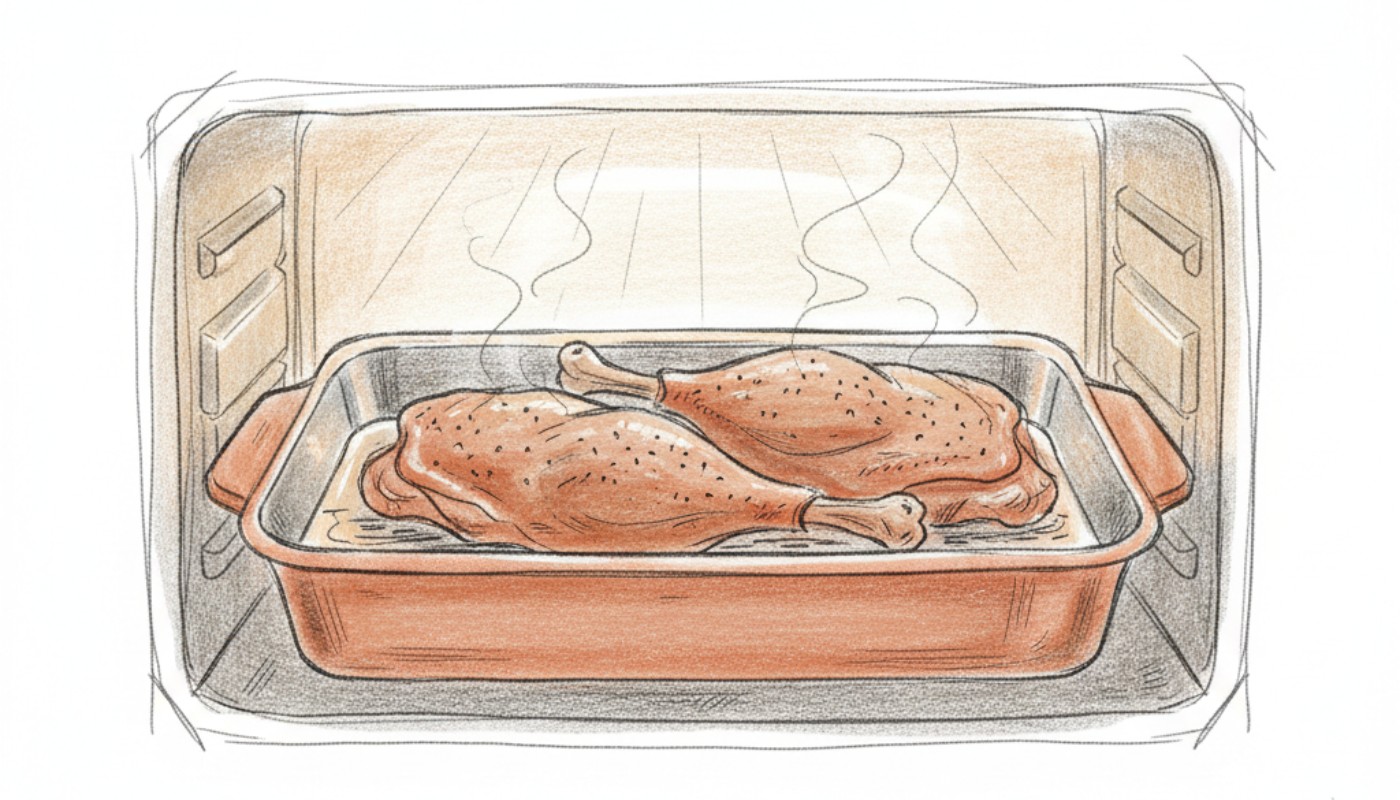
1 h 22 min – 1 h 38 min
Total oven time at 350°F / 175°C, before resting.
- Rest before carving
- 20 min
- Suggested prep-start time
- 15:42
This is a planning estimate, not a doneness test. Oven calibration, bird shape, and stuffing density all shift real cooking time by twenty minutes or more in either direction.
How this is calculated
Assumptions behind these numbers
- Base timings
- Per-kilo roasting ranges for a typical domestic oven at the stated temperature, drawn from established technique rather than lab testing.
- Stuffed birds
- Add 12% to total time as a planning allowance; a stuffed cavity also needs its own temperature check.
- Straight from the fridge
- Add 6% to total time for a bird that has not sat out to lose its chill.
- Resting
- A 20-minute rest is built into the schedule and assumed to be uncovered or loosely tented.
- Not modelled
- Oven calibration drift, convection versus conventional, bird shape, rack position, tray crowding, or altitude.
This is a planning estimate, not a doneness test — real cooking time routinely differs by twenty minutes or more. Finish every bird on a calibrated instant-read thermometer, not on the clock.
How the numbers work
Each oven-temperature preset uses a minutes-per-kilogram band drawn from common roasting practice: lower heat renders more fat and gives a wider, more forgiving window; higher heat crisps skin faster but narrows the margin for error. The planner multiplies that band by your bird's weight, then nudges it upward if the duck is stuffed or going in cold from the fridge — both slow how quickly heat reaches the centre.
The suggested prep-start time works backward from your target serving time, adding the top of the cooking range, a 20-minute rest, and a margin for carving and plating. Real ovens vary, so treat the first check-in point as the start of a window, not the finish line.
Common questions
- Why is the result a range instead of one number?
- Oven calibration, bird shape, and how tightly it's trussed all shift real cooking time. A range keeps expectations honest instead of implying false precision.
- Does the planner replace a thermometer?
- No. It only tells you roughly when to start checking. Doneness is always confirmed with a food thermometer, not a clock.
- Why do stuffed and fridge-cold birds take longer?
- Stuffing slows heat reaching the cavity, and a cold start means more of the cook goes into raising the bird's core temperature before it can brown.
References
- Safe Minimum Internal Temperature Chart — USDA Food Safety and Inspection ServiceAll poultry, including duck and duck pieces, is listed at a 165°F (73.9°C) safe minimum internal temperature.Reference checked 2026-08
- Duck and Goose from Farm to Table — USDA Food Safety and Inspection ServiceHandling, labelling, storage and cooking guidance specific to duck and goose.Reference checked 2026-08