
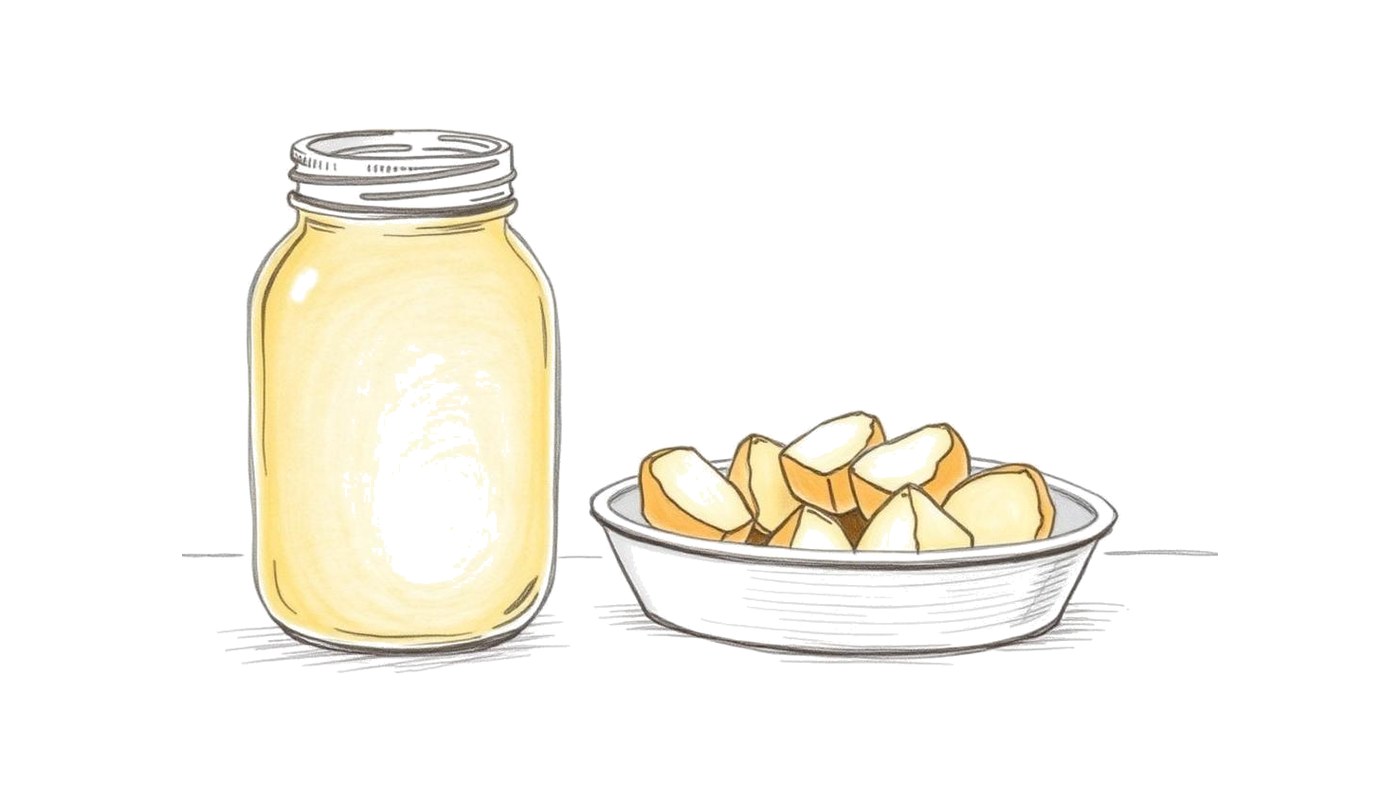
Duck fat is sold in enough formats and label variations that it's easy to buy the wrong size, the wrong purity, or more than you'll use before it turns. None of that requires guesswork — the format, the label, and a quick visual check tell you almost everything you need before you open the jar.
Updated
The short answer
- You want duck fat for roast potatoes a few times a year
- A small jar of plain rendered fatSmall formats let you finish the jar inside a sensible keeping window instead of nursing an old one.
- You're making confit
- A large tub, or render your own from trimConfit needs enough fat to submerge the legs, which is far more than a small jar holds.
- You already roast whole ducks
- Render your ownThe trim and pan drippings you are currently throwing away are the same ingredient you'd be buying.
- You want one flavour you can control
- Plain rendered fat, single ingredientSeasoned or blended fat makes a flavour decision for you in every dish you use it in.
Best options at a glance
The formats covered below, and who each one suits. Where a format has a verified seller link, it is here too. No prices, ratings, or stock claims.
Rendered duck fat in a glass jar
Best for: Roasting potatoes and everyday spoonfuls.
Large tub or pail (700 g+)
Best for: Confit, where you need enough fat to submerge the legs.
Tin or aerosol spray
Best for: Occasional use and pan-greasing.
Render it yourself from trim
Best for: Anyone already cooking whole ducks or breasts.
How we made these calls
We compare the formats rendered duck fat is sold in, plus rendering your own, on ingredient purity, how much you get, how you store it once opened, and the heat you intend to use it at.
What this is based on
- Label and ingredient-list conventions on retail rendered duck fat: what a single-ingredient label tells you versus a seasoned or blended one.
- Our own rendering, storage, and confit pages for keeping windows and quantities.
- General fat-handling practice — clean rendering, straining out juices, and judging fat by colour and smell before use.
Evaluation basis. Retail label and ingredient-list conventions on rendered duck fat, read against the storage windows and quantities on our rendering and confit pages. The comparison is by format rather than by brand.
Formats compared: jar, tub, tin, or render it yourself
The right format depends entirely on what you're cooking, not on which one looks like the better deal on the shelf. A tub that's cheap per gram is a poor buy if half of it turns before you get through it.
Label terms worth reading before you buy
Pure rendered means duck fat and nothing else — the ingredient list should say so plainly. Blended fat is cut with another fat, usually to reduce cost; it isn't inferior for every use, but it isn't a substitute where you specifically want duck flavour, such as confit or roast potatoes. Seasoned fat has salt or aromatics added — fine for finishing, risky if you're using it in a recipe that already accounts for seasoning separately.
Refined vs. unrefined is a flavour and smoke-point question more than a quality one. Unrefined fat carries more of the roasted, savoury character that makes duck fat worth seeking out in the first place. Refined fat is milder and more neutral — useful when you don't want the fat's flavour to dominate a dish.
Judging quality by eye before you cook with it
Colour and clarity tell you most of what a label can't. Good duck fat is pale gold and mostly translucent when melted, and solidifies to a soft, even, off-white when chilled. Cloudiness, a grey or brownish tint, or a visible separated layer of darker juice at the bottom of the jar are all signs the fat wasn't strained well or has started to turn — worth a sniff test before you commit it to a dish.
Storage after opening: honest keeping windows
Once opened, refrigerate duck fat and keep the container sealed between uses — it will pick up odours from the fridge otherwise. In the fridge, plan on using it within a few weeks for the best flavour, and treat any sign of off smell or cloudiness as a reason to discard it rather than push past it. Freezing extends that window substantially; portion it into smaller containers before freezing so you're not repeatedly thawing and refreezing the whole batch, which shortens its life every time.
How much you actually need
Buying the right size starts with knowing roughly how much a given use takes. These are practical planning amounts, not fixed rules.
| Use | Typical amount | Notes |
|---|---|---|
| Roast potatoes for four | 60–90 g (about ¼–⅓ cup) | Enough to coat and crisp without pooling in the tray. |
| Confit, legs fully submerged | 500 g–1 kg+ depending on pot size | Needs enough depth to cover the legs; a large tub is the practical format here. |
| Everyday searing or greasing a pan | 1–2 teaspoons per use | A small jar or tin lasts a long time at this rate. |
| Pan sauce or finishing drizzle | 1–2 tablespoons | Small amounts; flavour matters more than quantity. |
If you're substituting duck fat for another fat in a recipe, or the reverse, the duck fat substitution calculator converts quantities so you're not guessing at a 1:1 swap that may not hold.

The render-at-home alternative — and its real cost
If you already cook whole ducks or breasts regularly, rendering your own fat from trim is often the better economics — you're using a byproduct you'd otherwise throw away. The real cost isn't money, though; it's time and attention. Rendering properly takes roughly an hour of low, steady heat, and straining it well is what actually determines how long it keeps — leftover juices left in the fat are the most common reason home-rendered fat spoils earlier than store-bought. See how to render duck fat for the full method, and ways to use duck fat once you've got a jar of it, homemade or bought.
Buying specifically for confit
Confit is the one use where format matters most: the legs need to be fully submerged, so buying jar-sized portions for a confit batch means buying several jars, which is both more expensive and more wasteful than one large tub. See duck leg confit for the quantities a typical batch actually needs before you shop.
The decision matrix
Four ways to end up with duck fat in your kitchen, compared on the things that decide it.
| What you're deciding on | Small jar | Large tub / tin | Seasoned or blended | Rendered at home |
|---|---|---|---|---|
| Ingredient purity | Read the list — plain fat should be one ingredient | Same check applies; volume doesn't change the label | Contains added aromatics, salt, or other fats by design | Exactly what you put in, and nothing else |
| Volume vs. use | Enough for pan cooking and roast vegetables | The only practical format for confit | Whatever the jar holds; flavour limits the uses | As much as your trim and drippings yield |
| Storage after opening | Refrigerate; keep it clean and covered | Refrigerate, or portion and freeze what you won't use soon | Refrigerate; treat as a shorter-life product than plain fat | Strain well, refrigerate or freeze in portions |
| Heat suitability | Fine for roasting and pan cooking | Same, in larger quantities | Added solids can scorch before the fat would | Depends on how well you strained the meat juices out |
| Intended use | Potatoes, root vegetables, eggs, searing | Confit, batch roasting | One dish you want that flavour in | Anything, including topping up a confit batch |
| Effort | None | None | None | A low, slow render plus straining and storage |
Who each option is for
Listed in no particular order. We don't rank these, because the right answer changes with how you cook rather than with any score we could assign.
Small glass jar
Good fit: Occasional use where finishing it within the keeping window matters.
Not for: Confit or anything needing volume.
Large tub or tin
Good fit: Confit, frequent roasting, or a household that cooks with duck fat weekly.
Not for: Anyone who will open it once and forget it at the back of the fridge.
Seasoned or blended fat
Good fit: Cooks who want one specific flavoured application and nothing else.
Not for: General-purpose cooking, where the added flavour follows you everywhere.
Rendered at home
Good fit: Anyone already cooking whole ducks or breasts with trim to spare.
Not for: Someone who needs a large volume today and has no duck on hand.
Compare the formats
| Option | Format | Best use | After opening | Label check |
|---|---|---|---|---|
| Rendered duck fat in a glass jar | Typically 200–350 g; resealable and easy to scoop cold. | Roasting, frying, finishing. | Refrigerate after opening and keep the rim clean. | Ingredients should read as duck fat, nothing else, unless you want seasoning. |
| Large tub or pail (700 g+) | 700 g to several kilograms. | Confit and repeated deep applications. | Refrigerate; decant working amounts to avoid repeated warming. | Check whether it is pure rendered fat or blended with other fats. |
| Tin or aerosol spray | Small tins, or sprays cut with other oils and propellant. | Greasing, light finishing. | Follow the label; tins usually want refrigeration once opened. | Sprays are frequently blends — read the ingredient list before assuming purity. |
| Render it yourself from trim | As much as your birds give you — usually 100–250 g per whole duck. | Everything a jar does. | Refrigerate in a clean sealed jar; freeze for longer keeping. | Strain properly — leftover juices are what make home-rendered fat spoil early. |
Rendered duck fat in a glass jar
Best for: Roasting potatoes and everyday spoonfuls.
- Format
- Typically 200–350 g; resealable and easy to scoop cold.
- Best use
- Roasting, frying, finishing.
- After opening
- Refrigerate after opening and keep the rim clean.
- Label check
- Ingredients should read as duck fat, nothing else, unless you want seasoning.
Why it stands out
- The most useful size for a household that roasts potatoes a few times a month.
- Glass lets you see clarity and any separated juices at the bottom.
What to check
- Costs more per gram than a large tub or tin.
No verified seller link yet
Details checked 2026-08
Large tub or pail (700 g+)
Best for: Confit, where you need enough fat to submerge the legs.
- Format
- 700 g to several kilograms.
- Best use
- Confit and repeated deep applications.
- After opening
- Refrigerate; decant working amounts to avoid repeated warming.
- Label check
- Check whether it is pure rendered fat or blended with other fats.
Why it stands out
- Confit is impractical at jar quantities — this is the format that makes it possible.
- Best cost per gram.
What to check
- Takes real fridge space.
- Warming a whole tub repeatedly shortens its life; decant instead.
No verified seller link yet
Details checked 2026-08
Tin or aerosol spray
Best for: Occasional use and pan-greasing.
- Format
- Small tins, or sprays cut with other oils and propellant.
- Best use
- Greasing, light finishing.
- After opening
- Follow the label; tins usually want refrigeration once opened.
- Label check
- Sprays are frequently blends — read the ingredient list before assuming purity.
Why it stands out
- Convenient, and hard to over-pour.
What to check
- Sprays often contain far less duck fat than the front label implies.
- Poor value per gram for roasting.
No verified seller link yet
Details checked 2026-08
Render it yourself from trim
Best for: Anyone already cooking whole ducks or breasts.
- Format
- As much as your birds give you — usually 100–250 g per whole duck.
- Best use
- Everything a jar does.
- After opening
- Refrigerate in a clean sealed jar; freeze for longer keeping.
- Label check
- Strain properly — leftover juices are what make home-rendered fat spoil early.
Why it stands out
- Free, and it is the same product you'd otherwise buy.
- You control how clean the strain is, which decides how long it keeps.
What to check
- Takes an hour of low, attentive heat.
- Yield is unpredictable until you've done it with your usual birds.
No verified seller link yet
Details checked 2026-08
Evaluation basis: published specifications, manufacturer or seller documentation, and the duck-specific cooking requirements explained in this guide. Editorial standards
Shop this guide
What this guide actually asks you to own. If you already have a working version, keep it.
A tub sized for what you're actually cooking
Confit needs submersion depth; everyday roasting needs far less. Match the size to the use, not the unit price.
See confit quantitiesA plan for fat rendered at home
If you already cook whole ducks or breasts, you may not need to buy fat at all.
See how to render and store it
Cooking duck tonight? Don't guess.
Most disappointing duck dinners start at the point of purchase. The playbook includes the shopping checklist we use before anything hits a pan. Tell us what you're cooking in the Duck Game Plan and we'll build your temperature, timing, crispy-skin and serving plan. Subscribers also get Duck the Fundamentals, the printable 28-page playbook, a short welcome series, and occasional DeliciousDuck recipes and guides.
- What to check on the label, and what breed choice changes
- A first-duck shopping checklist you can take to the counter
- How to store, thaw, and portion what you buy
- A printable kitchen card with temperatures and timings
You can also read our companion article, the Duck Cooking Starter Guide, plus the temperature and doneness guide and the calculators, right now.
Common questions
- Is unrefined duck fat better than refined?
- Better for flavour, usually — unrefined fat keeps more of the roasted, savoury character. Refined fat is milder and more neutral, which some cooks prefer for delicate dishes. Neither is objectively superior; it depends on what you're making.
- How can I tell if a jar has gone bad?
- Look and smell before you cook with it. Fresh duck fat is pale gold and smells clean and faintly roasted. Discard it if it smells sour, sharp, or like old cooking oil, or if you see cloudy separation with a layer of darkened juice at the bottom that wasn't there when you opened it.
- Does duck fat need to be refrigerated?
- Once opened, yes — refrigeration meaningfully extends how long it stays good. An unopened, commercially sealed jar can often sit in a pantry, but check the label; once you break the seal, treat it like any other opened animal fat.
- Is it cheaper to render duck fat myself?
- Per gram, usually yes, since you're using trim you'd otherwise discard. It isn't free of cost, though — it takes roughly an hour of low, attentive heat, and yield varies enough between birds that it's worth doing a couple of times before you rely on it for a specific recipe.
Related guides
- How to Render Duck FatFrom trim to a clean jar, plus honest storage windows.
- Duck-Fat Substitution CalculatorSwap butter or oil for duck fat across tbsp, cups and grams.
- 15 Ways to Use Duck FatWhere duck fat beats butter or oil, and where it's just expensive.
- Duck Leg ConfitCure, poach, chill, crisp — and the storage rules people get wrong.
- Where to Buy Duck OnlineEight things to compare before you pay for cold-chain shipping.
- Duck Fat vs Butter, Olive Oil & Neutral OilA reference table for choosing the fat, not defaulting to it.
- Fresh vs Frozen DuckFrozen isn't a downgrade — it's a scheduling decision.
- Best Pot for Duck ConfitFit beats brand — and you may already own the right pot.
- Duck Fat Roasted PotatoesParboiled, roughed up, and roasted in preheated duck fat until the outsides shatter and the insides stay fluffy.
- Is Duck Healthy?The real numbers for skin-on and skin-off duck, and how duck fat actually compares.