
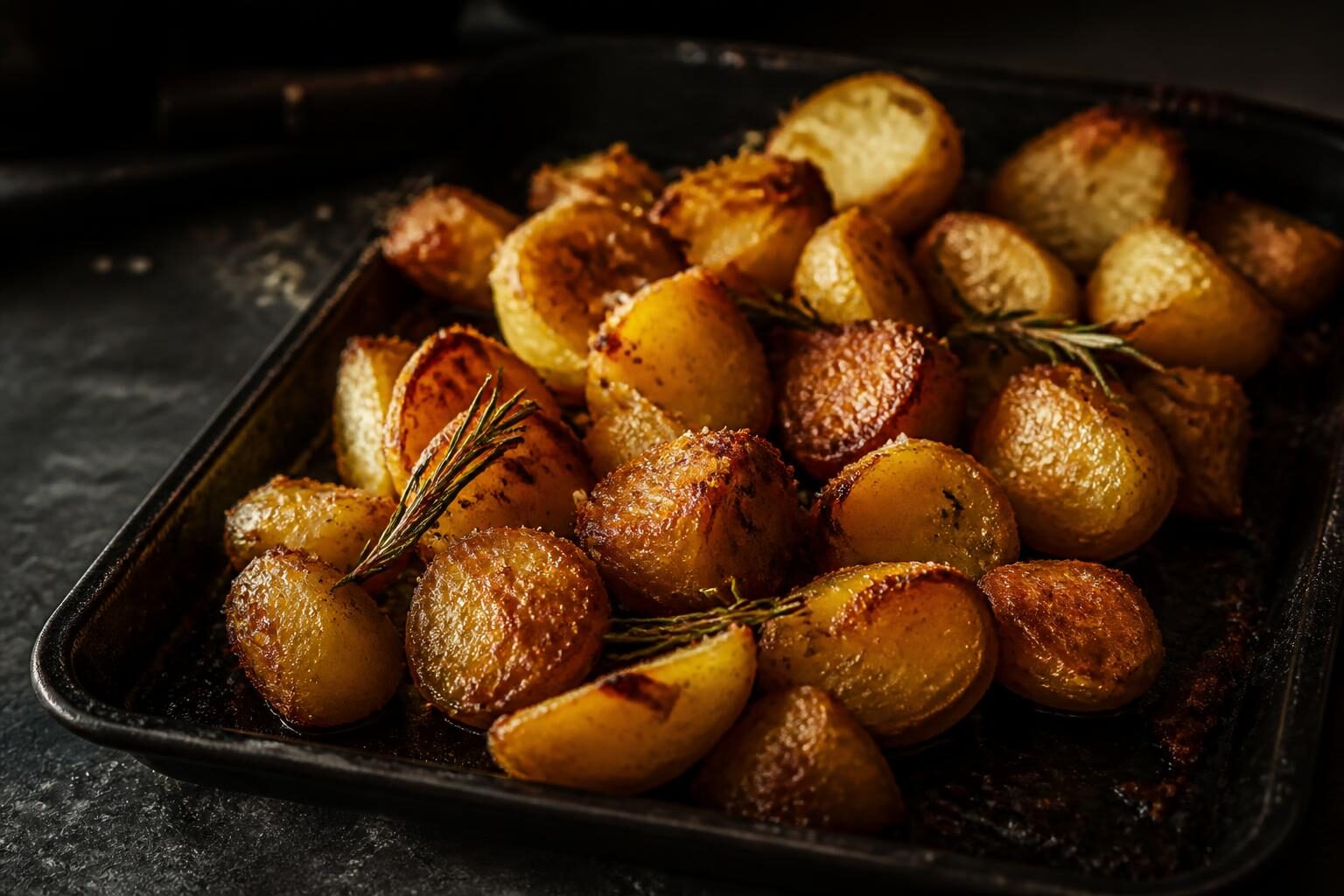
Method basis: established culinary technique and published food-safety guidance. Go by the visual and texture cues in the method rather than by the clock. Editorial standards
Ingredients
For the potatoes
- 1.2 kg (2½ lb) floury or all-rounder potatoes — Maris Piper, King Edward, russet, or Yukon Gold
- 90 g (about ⅓ cup) rendered duck fat
- 1 tbsp fine salt, for the parboiling water
- Flaky sea salt, to finish
Optional aromatics
- 4 garlic cloves, unpeeled and lightly crushed
- 3 sprigs rosemary or thyme
- Freshly cracked black pepper, to finish
Cooking for a different number? Scale the quantities rather than guessing — fat and salt do not scale linearly with guest count.
Equipment that matters
Heavy metal roasting tray
Metal takes and gives back heat fast, which is what fries the cut faces on contact. Glass and ceramic heat slowly and tend to steam the undersides.
Large saucepan and a colander
The parboil needs room for the potatoes to move; draining well and letting them steam dry is what makes the roughing-up step work.
Fish slice or thin metal spatula
Turning potatoes that have bonded to the tray is how the crust gets torn off. A thin edge lifts them cleanly.
Before you start
Choose the right potato
Floury varieties — Maris Piper, King Edward, russet — break down slightly at the surface during the parboil, which is exactly the rough, starchy layer that crisps. Waxy potatoes hold their shape and stay smooth, so they roast pleasantly but never get that craggy shell. All-rounders like Yukon Gold sit in between and work well. Cut into even 4–5 cm (1½–2 in) pieces so they finish together.
Preheat the fat, not just the oven
Put the duck fat in the tray and slide it into the oven while it comes up to temperature. Potatoes dropped into hot fat start frying immediately; potatoes sitting in cold fat as it warms release moisture and steam their own surfaces soft. This one step accounts for more of the difference than any brand of fat.
Salt the water, finish with salt too
Salting the parboiling water seasons the potato all the way through — you cannot fix that later from the outside. Salt on the surface, though, draws moisture, so hold the flaky salt back until the potatoes come out of the oven, when it stays on the crust rather than softening it.
Method, step by step
Heat the oven and the fat
Heat the oven to 220°C / 425°F (200°C / 400°F fan). Spoon the duck fat into a heavy metal roasting tray large enough to hold the potatoes in a single layer with gaps, and put the tray in the oven to heat.
Watch for If the tray looks tight for 1.2 kg of potatoes, use two trays. Crowding is the most common reason roast potatoes come out pale.
Parboil for 8–10 minutes
Put the cut potatoes in a large pan, cover with cold water, add the tablespoon of salt, and bring to a boil. Simmer 8–10 minutes from boiling — until a knife tip slides into the outer layer but meets resistance in the centre.
Watch for Edges starting to fluff and blur is the signal you want. Pieces collapsing mean you have gone too far; drain immediately and handle them gently.
Drain and steam dry
Drain thoroughly in a colander and leave them for 3–4 minutes. The residual heat drives off surface water, and a dry surface is what lets the fat get to work instead of boiling moisture away.
Rough up the edges
Put the lid on the pan or the colander and shake firmly two or three times, or scuff each piece with a fork. You want a fuzzy, broken outer layer on every face — that ragged starch is the future crust, and smooth potatoes simply cannot produce it.
Watch for Fuzzy, not mashed. If pieces are falling apart, one gentle shake is enough.
Into the hot fat
Pull the tray out and add the potatoes in one layer, turning each piece so it is coated, with a cut face against the metal. Leave a finger's width between pieces. Add the garlic and herbs now if you are using them.
Watch for You should hear an immediate sizzle. Silence means the fat was not hot enough — give the tray a few more minutes in the oven next time.
Roast 25 minutes, then turn
Roast undisturbed for 25 minutes, then turn each potato onto a fresh face and roast for another 20–30 minutes, turning once more if the browning looks uneven.
Watch for Do not turn early. Potatoes need to release from the tray on their own; forcing them at 10 minutes tears the crust off.
Finish and serve
The potatoes are done when they are deep golden brown, sound hollow and hard when tapped with a spoon, and give no resistance to a skewer through the middle. Lift them out of the fat onto a warm dish, season with flaky salt and pepper, and serve straight away.
Watch for Left sitting in the fat or covered with foil, the crust softens within minutes. Serve them uncovered.
Temperatures and timings
| Stage | Setting | Time | What you are looking for |
|---|---|---|---|
| Preheat fat in tray | 220°C / 425°F | 10–15 min | Fat fully liquid and shimmering |
| Parboil | Simmering water, salted | 8–10 min | Knife enters the edge, centre still firm |
| Steam dry | Off heat, in the colander | 3–4 min | Surface matte and dry to the touch |
| First roast | 220°C / 425°F | 25 min | Undersides set and releasing from the tray |
| After turning | 220°C / 425°F | 20–30 min | Deep golden on two or three faces, hollow-sounding |
Quack Fix
The four ways this recipe usually goes wrong, what to do about it mid-cook, and how to stop it happening again.
Pale and greasy rather than crisp
- Likely cause
- The fat was cold when the potatoes went in, so they absorbed it instead of frying in it.
- Fix now
- Turn the oven up 10°C / 25°F and give them another 10–15 minutes, turning once. Some crust usually still comes.
- Prevent next time
- Preheat the fat in the tray while the oven heats, and listen for a sizzle as the potatoes land.
Smooth, hard shells with no craggy crust
- Likely cause
- Either a waxy potato or the roughing-up step was skipped.
- Fix now
- Nothing rescues the surface mid-roast; roast them to deep gold and enjoy them as they are.
- Prevent next time
- Use a floury or all-rounder variety and shake the drained potatoes until the edges look fuzzy.
Insides gluey or waterlogged
- Likely cause
- Overboiled, or drained and dressed while still wet.
- Fix now
- Spread them further apart and keep roasting — extra time drives off some of the moisture.
- Prevent next time
- Parboil to firm-centred only, then let them steam dry in the colander before the fat.
Some burnt, some still pale
- Likely cause
- Uneven piece sizes, an overcrowded tray, or oven hot spots.
- Fix now
- Move the darkest pieces to the cooler edge of the tray and rotate the tray front to back.
- Prevent next time
- Cut to an even size, leave gaps between pieces, and use two trays for larger batches.
Save what's left
Two things are worth keeping after this tray comes out, and one of them is worth more than the potatoes.
Fat left in the tray
Strain it through a fine sieve into a clean jar while warm, then refrigerate. It has picked up potato starch and salt, so use it for another tray of potatoes or vegetables rather than a delicate sauce, and discard it once it smells anything but clean.
Straining and storing rendered fatCold roast potatoes
Refrigerate within two hours in a shallow container and eat within 3–4 days. Reheat spread out on a hot tray at 200°C / 400°F for 10–12 minutes; a microwave will make them soft.
Garlic and herbs from the tray
Squeeze the soft garlic into a mayonnaise or mash it into butter for whatever you are serving alongside.
On a holiday table these are best roasted earlier in the day and re-crisped while the bird rests, which is exactly how they are scheduled in our Thanksgiving duck dinner plan
Render it, buy it, or swap it?
This tray takes about 90 g of fat. Which way you get hold of it depends on what is already in your kitchen — all three answers make good potatoes.
You have trim, skin or a roasting tray
Render it yourself
Fat off a bird you already cooked is the same product as a tub, for the price of about an hour of low heat and careful straining.
How to render duck fatYou want it ready, or you need a lot of it
Buy it rendered
A jar covers two or three trays. The guide covers formats, what the label terms mean, and how long an opened container keeps once you are into it.
Duck fat buying guideThe dish doesn't hang on duck flavour
Use another fat
No fat in the house tonight? Beef dripping or a high-heat oil still crisps — the calculator converts the amount so you are not guessing at a swap.
Work out the swap
Common questions
- Do I have to parboil the potatoes?
- You can roast them raw, but you will not get the same shell. Parboiling gelatinises the starch at the surface so the roughing-up step produces a rough, starchy layer that fries crisp. Raw potatoes roast to a smoother, denser surface and take longer to cook through.
- How much duck fat do I need for a tray of potatoes?
- For 1.2 kg of potatoes, about 90 g (roughly ⅓ cup) is enough to coat everything and leave a shallow film in the tray. You are frying the contact faces, not deep-frying, so more fat mostly means more fat to strain afterwards.
- Can I use a different fat?
- Yes — beef dripping, lard, or a high-heat neutral oil all crisp well, since all of them are close to pure fat. What changes is flavour: duck fat brings a savoury, roasted note the others do not. Butter on its own is the poor choice here, because its water and milk solids steam the surface and burn before the potatoes are done.
- Can I get these ready in advance?
- Partly. Parboil, drain, rough up and refrigerate the potatoes uncovered on a tray up to a day ahead — the extra drying time in the fridge helps rather than hurts. Roast them from cold in preheated fat and allow about five extra minutes. Fully roasting ahead and reheating gives you a good potato, not a great one.
- Why did my potatoes stick to the tray?
- Almost always because they were turned too early. Potatoes bond to hot metal while the crust is forming and release on their own once it sets. Leave the first side a full 25 minutes and use a thin metal spatula rather than tongs.
- Can I reuse the fat from the tray?
- Once or twice, if you strain it while it is still warm and keep it refrigerated. It carries starch and salt from the potatoes, which shortens how long it keeps, so use it for roasting rather than saving it long-term, and throw it out if it smells sour or sharp.
Related guides
The technique guides and calculators behind this recipe.
- 15 Ways to Use Duck FatWhere duck fat beats butter or oil, and where it's just expensive.
- How to Render Duck FatFrom trim to a clean jar, plus honest storage windows.
- Duck Fat vs Butter, Olive Oil & Neutral OilA reference table for choosing the fat, not defaulting to it.
- Recipe ScalerScale any ingredient list from its original servings to yours.
- Duck Leg ConfitSalt-cured legs poached slowly in their own fat, then crisped to order — the most forgiving duck there is.
- Roasted Whole DuckA two-stage roast that renders the fat cap, keeps the breast juicy, and gets the legs fully tender.
- Peking Duck at HomeA home cook's route to lacquered, shatter-crisp Peking-style duck: air-dry, scald, glaze, and roast, served with pancakes, scallion and hoisin.