
Method basis: established culinary technique and published food-safety guidance. Cook to the stated internal temperatures rather than to the clock. Editorial standards
Ingredients
For the duck
- 1 whole Pekin duck, 2–2.5 kg (4.5–5.5 lb), fully thawed
- 2 litres (8 cups) water, for scalding
- 2 tbsp maltose or honey
- 1 tbsp Shaoxing wine (or dry sherry)
- 1 tbsp rice vinegar
- 1 tsp fine sea salt
To serve
- 12–16 thin Mandarin pancakes, steamed
- 6 scallions, cut into fine batons
- ½ cucumber, seeded and cut into batons
- 60 ml (¼ cup) hoisin or sweet bean sauce
Cooking for a different number? Scale the quantities rather than guessing — fat and salt do not scale linearly with guest count.
Equipment that matters
Deep roasting tray and wire rack
The duck has to sit clear of its own rendering fat for the whole roast, and a domestic tray needs the depth to hold it.
Roasting pan buying guideInstant-read thermometer
Whole-bird timings vary with weight and oven. Thigh temperature is the only reliable signal that the legs are done.
Thermometer buying guideFridge shelf space, uncovered
The drying stage is the recipe. Twelve to twenty-four hours of cold, moving air is what makes the skin lacquer rather than steam.
Before you start
Loosen the skin, then scald it
Pat the duck dry and slide a finger or the handle of a spoon between skin and breast meat to separate them where you can, without tearing. Set the duck on a rack in the sink and ladle boiling water over it for a minute or two, turning, until the skin tightens and turns opaque. The scald shrinks the skin away from the fat and opens it to the glaze.
Glaze and dry
Warm the maltose or honey with the wine, vinegar and salt until pourable, then brush a thin coat over the whole bird. Set it breast-up on a rack over a tray and refrigerate uncovered for 12–24 hours. The skin should feel dry and parchment-like before it goes near the oven — tacky skin means it needs longer.
Method, step by step
Bring the duck to room temperature briefly
Take the duck out 30 minutes before roasting so the surface is not fridge-cold going in, and give it a second thin coat of glaze. Do not leave a whole bird out longer than that; perishable food should not sit between 40°F and 140°F for more than two hours in total.
Roast hot to set the skin
Heat the oven to 425°F (220°C) convection off. Roast the duck breast-up on the rack for 25 minutes, until the skin is tightening and colouring at the edges.
Watch for A little smoke from fat hitting the tray is normal. If it is more than a little, add a cup of water to the tray.
Drop the heat and render
Reduce to 325°F (165°C) and continue for 60–75 minutes, pouring the fat out of the tray twice along the way. This is where the fat cap leaves and the legs turn tender.
Watch for If the breast skin is racing ahead of the legs, tent the breast loosely with foil.
Finish hot for lacquer
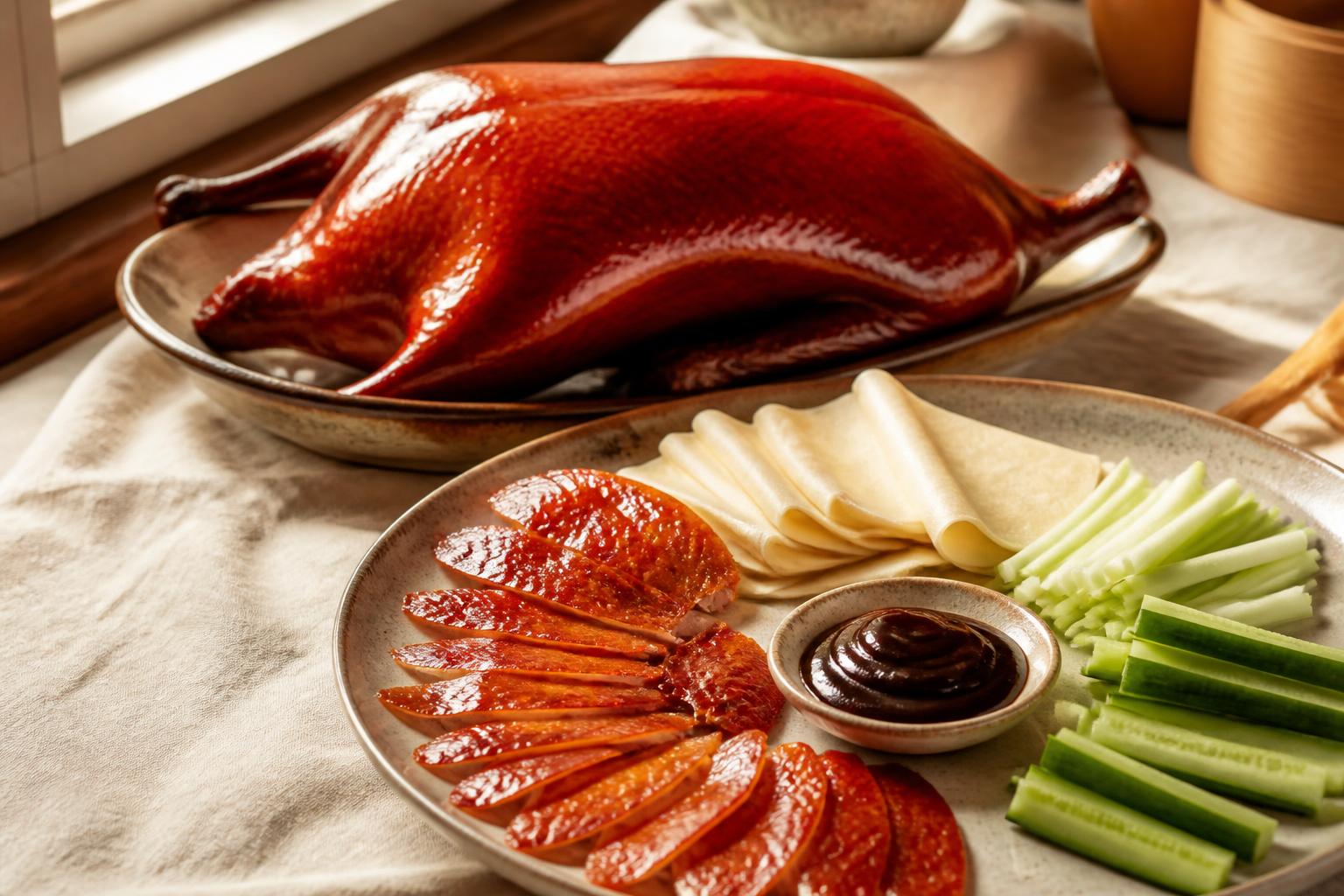
Raise the heat back to 425°F (220°C) for a final 10–15 minutes to bring the skin to a deep, even mahogany with a glassy surface.
Watch for The sugars in the glaze can go from mahogany to bitter in a couple of minutes. Watch it, do not time it.
Check the thigh, then rest
Probe the thickest part of the thigh, avoiding bone: 175–185°F (79–85°C) means the legs are properly tender rather than merely safe. Rest, uncovered, on a rack for 15 minutes so the skin stays crisp.
Watch for The safe minimum internal temperature for all poultry, duck included, is 165°F (73.9°C). Whole-bird legs simply eat better well past it.
Carve skin first, then meat
Slice the crisp skin off in broad pieces and serve it separately — this is the part guests are waiting for. Then carve the breast into thin slices and pull the leg meat. Build pancakes with a smear of hoisin, scallion, cucumber, a slice of meat and a shard of skin.
Temperatures and timings
| Stage | Oven | Time or target |
|---|---|---|
| Set the skin | 425°F (220°C) | 25 minutes |
| Render | 325°F (165°C) | 60–75 minutes, drain fat twice |
| Lacquer | 425°F (220°C) | 10–15 minutes, watch closely |
| Thigh, for tenderness | — | 175–185°F (79–85°C) |
| Poultry safe minimum | — | 165°F (73.9°C) |
Quack Fix
The four ways this recipe usually goes wrong, what to do about it mid-cook, and how to stop it happening again.
Skin is leathery rather than crisp
- Likely cause
- Not dry enough before roasting, so the first stage steamed it.
- Fix now
- Give it a further 8–10 minutes at 425°F (220°C) and serve the skin separately from the meat.
- Prevent next time
- Let the glazed bird dry uncovered in the fridge for a full 24 hours next time.
Glaze turned dark and bitter
- Likely cause
- Sugar burned during the final high-heat stage.
- Fix now
- Trim the darkest patches; the rest of the skin is still good.
- Prevent next time
- Glaze thinly, and treat the last stage as a watched 10 minutes rather than a set 15.
Breast dry by the time the legs were tender
- Likely cause
- Whole-bird cooking always pulls the breast past rosy — the fix is protection, not timing.
- Fix now
- Slice the breast thin and serve it with the pan juices and plenty of skin.
- Prevent next time
- Tent the breast with foil through the render stage, and carve legs and breast separately.
Kitchen filled with smoke
- Likely cause
- Rendered fat pooling and overheating in the tray.
- Fix now
- Carefully pour the fat off and add a cup of water to the tray.
- Prevent next time
- Drain the tray twice during the render stage, every time.
Use the Whole Duck
Nothing here needs to go in the bin. Each of these is worth more than the packaging suggests.
Rendered fat
Strain and keep it — this is the best batch of duck fat you will get all year.
Fifteen uses for duck fatCarcass
Simmer into a deep broth for noodles; the bones from a glazed bird make a darker stock than usual.
Leg and shoulder meat
Shred into pancakes, fried rice, or a cold salad the next day.
Shop this guide
Where to source what this recipe needs.
Buying a whole duck
Pekin at 2–2.5 kg is the size this method is written for, and frozen whole birds need a full day or more of fridge thawing before the drying stage begins.
Where to buy duck online
Common questions
- Can you make Peking duck without a special oven?
- Yes. What a Peking oven gives you is fierce radiant heat and hanging airflow; a domestic oven with the bird on a wire rack over a deep tray gets close, provided you do the scald and the long uncovered dry.
- Do I need maltose?
- No. Maltose gives the most authentic glassy lacquer, but honey thinned with wine and vinegar browns very similarly. Use whichever you can get.
- How long does the skin need to dry?
- Twelve hours uncovered in the fridge is the minimum; twenty-four is better. The test is touch, not the clock — the skin should feel dry and papery, with no tackiness.
- What duck should I buy?
- A whole Pekin duck of 2–2.5 kg (4.5–5.5 lb). It is the breed the dish was built around and the one sold in most US supermarkets and online duck suppliers.
- Is it safe to serve Peking duck with pink meat near the bone?
- Cook whole duck until the thigh reads at least 165°F (73.9°C), the safe minimum for all poultry. In practice the legs taste better at 175–185°F (79–85°C), which puts safety well behind you.
Related guides
The technique guides and calculators behind this recipe.
- Whole Roast DuckThe full workflow, from dry-fridge prep to a rested, carvable bird.
- Why Duck Skin Won't CrispSeven symptoms, seven causes, and the fix you can still apply mid-cook.
- How to Render Duck FatFrom trim to a clean jar, plus honest storage windows.
- Whole-Duck Serving CalculatorTurn a guest count into how many birds to buy.
- Interactive Duck Doneness GuideTargets, probe placement and carryover by cut and method.
- Roasted Whole DuckA two-stage roast that renders the fat cap, keeps the breast juicy, and gets the legs fully tender.
- Duck à l’OrangeA whole duck roasted in two stages, served with a bitter-orange gastrique built from the pan drippings — sharp and glossy rather than sweet.
References
- Safe Minimum Internal Temperature Chart — USDA Food Safety and Inspection ServiceAll poultry, including duck and duck pieces, is listed at a 165°F (73.9°C) safe minimum internal temperature.Reference checked 2026-08
- Duck and Goose from Farm to Table — USDA Food Safety and Inspection ServiceHandling, labelling, storage and cooking guidance specific to duck and goose.Reference checked 2026-08
- The Big Thaw — Safe Defrosting Methods — USDA Food Safety and Inspection ServiceRefrigerator, cold-water and microwave thawing are the three methods considered safe; room-temperature thawing is not.Reference checked 2026-08
- Danger Zone (40°F – 140°F) — USDA Food Safety and Inspection ServicePerishable food should not sit between 40°F and 140°F for more than two hours.Reference checked 2026-08