
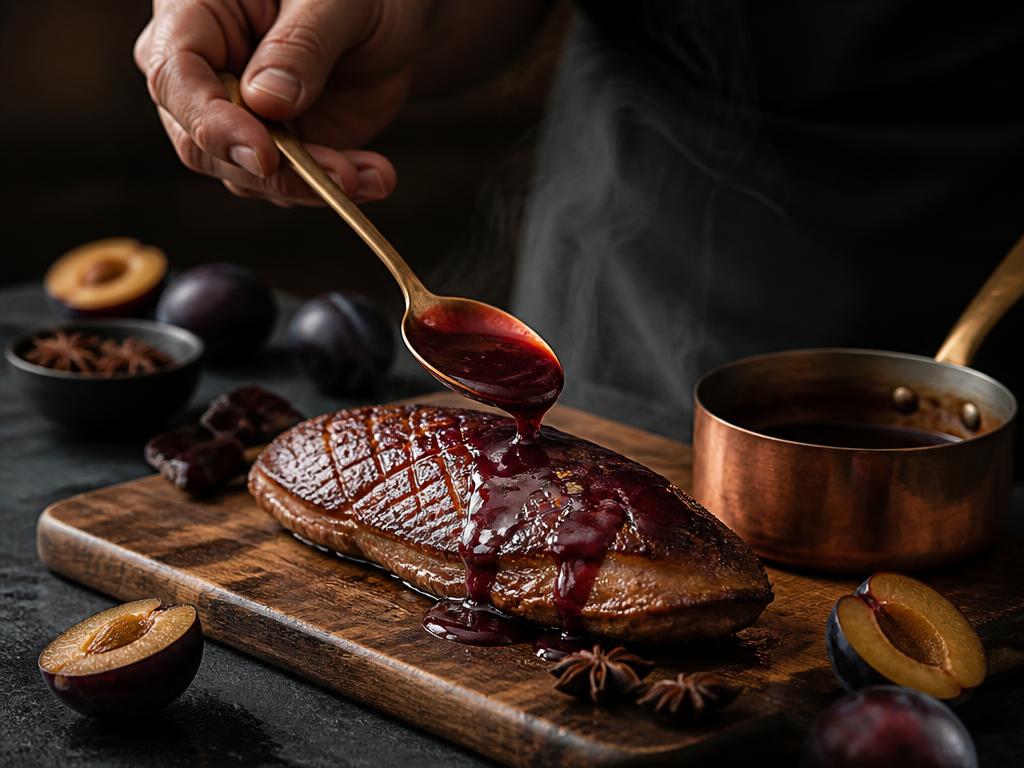
Method basis: established culinary technique and published food-safety guidance. Cook to the stated internal temperatures rather than to the clock. Editorial standards
Ingredients
Duck and cure
- 1 whole duck (2–2.7 kg / 4.5–6 lb) or 2 bone-in duck breasts
- 2 tbsp coarse salt
- 1 tbsp brown sugar
- 1 tsp cracked black pepper
- ½ tsp five-spice powder (optional)
Plum sauce
- 500 g (1 lb) ripe plums, stoned and quartered
- 1 small shallot, sliced
- 2 tbsp rice vinegar or cider vinegar
- 1–2 tbsp honey, to taste
- 1 tsp soy sauce
- 1 star anise
- A pinch of chilli flakes
Smoke
- Fruitwood chunks — cherry, apple or plum — not mesquite or heavy hickory
Cooking for a different number? Scale the quantities rather than guessing — fat and salt do not scale linearly with guest count.
Equipment that matters
Leave-in probe thermometer
Opening a smoker to check temperature costs heat and time. A probe lets you track the breast without lifting the lid.
Thermometer buying guideDrip tray
Duck renders a lot of fat. Fat on coals means flare-ups and acrid smoke.
Before you start
Dry-cure, then air-dry
Rub the salt, sugar, pepper and optional five-spice over the bird and refrigerate uncovered for 8–12 hours. Rinse lightly, pat dry, and leave uncovered another 2–4 hours so the surface forms a dry pellicle that smoke adheres to.
Pick the right wood
Fruitwoods complement duck; heavy woods overwhelm it. Aim for thin blue smoke, never thick white smoke.
Method, step by step
Score and set up the smoker
Score the fat cap shallowly to help it render. Bring the smoker to a steady 225–250°F (107–121°C) with a drip tray under the bird.
Smoke to temperature, not to time
Smoke for roughly 1.5–2.5 hours depending on cut and size. Breast should reach 130–140°F (54–60°C); legs on a whole bird want 175–185°F (79–85°C).
Watch for If the legs lag badly behind, separate the bird into breast and leg pieces next time and smoke them apart.
Make the plum sauce while it smokes
Simmer plums, shallot, vinegar, honey, soy, star anise and chilli for 20–25 minutes until collapsed and glossy. Blend for a smooth sauce or leave it chunky. It should taste distinctly sharp on its own — against duck fat it will read as balanced.
Watch for Taste for acidity, not sweetness. Under-acidic plum sauce makes the whole plate cloying.
Finish hot for the skin
Smoked skin is rarely crisp on its own. Finish under a hot broiler or in a 450°F (230°C) oven for 5–10 minutes, or sear the breast skin-side down in a dry pan.
Watch for Sugar from the cure browns fast — stay with it.
Rest and slice
Rest 10 minutes, then slice the breast across the grain and serve with the plum sauce spooned alongside.
Watch for The safe minimum for all poultry is 165°F (73.9°C); smoking to a lower breast temperature is a culinary choice.
Temperatures and timings
| Stage | Target | Notes |
|---|---|---|
| Smoker chamber | 225–250°F (107–121°C) | Steady and clean; thin blue smoke |
| Breast pull | 130–140°F (54–60°C) | Before the hot finish |
| Leg / thigh | 175–185°F (79–85°C) | Needs longer than the breast |
| USDA recommendation | 165°F (73.9°C) | Food-safety minimum for poultry |
Quack Fix
The four ways this recipe usually goes wrong, what to do about it mid-cook, and how to stop it happening again.
Bitter, ashy flavour
- Likely cause
- Thick white smoke, or fat dripping onto coals.
- Fix now
- Serve with extra plum sauce and acidic sides; the sharpness masks a lot.
- Prevent next time
- Use a drip tray, fewer wood chunks, and wait for thin blue smoke before the bird goes in.
Skin is leathery, not crisp
- Likely cause
- Low-temperature smoke dries skin without crisping it.
- Fix now
- Blast under a hot broiler for a few minutes.
- Prevent next time
- Always plan a hot finishing stage into the cook.
Sauce tastes flat and sugary
- Likely cause
- Not enough acid to balance the honey and the fat.
- Fix now
- Add vinegar a teaspoon at a time until it tastes slightly too sharp on the spoon.
- Prevent next time
- Season the sauce against a bite of duck, not on its own.
Use the Whole Duck
Nothing here needs to go in the bin. Each of these is worth more than the packaging suggests.
Smoked drippings
Strain and use sparingly — a spoonful flavours a whole pot of beans or greens.
Fifteen uses for duck fatSmoked carcass
A smoked duck stock makes an exceptional base for noodle soup.
Extra plum sauce
Keeps 3–4 days in the fridge; excellent with pork, cheese, or cold duck sandwiches.
Shop this guide
Where to source what this recipe needs.
Buying duck for smoking
Bone-in breast and whole birds smoke better than boneless breast, which dries out over a long cook.
Where to buy duck online
Common questions
- What wood is best for smoking duck?
- Fruitwoods — cherry, apple, plum. They are mild enough to sit behind the duck rather than dominate it. Mesquite and heavy hickory tend to overwhelm poultry fat.
- Can I smoke duck in a kettle grill?
- Yes. Bank the coals to one side, add a wood chunk, put a drip tray under the duck on the cool side, and manage the vents to hold 225–250°F (107–121°C).
- Do I need to cure the duck first?
- It is not mandatory, but a short dry cure seasons the meat through and dries the surface so smoke adheres and skin finishes better.
Related guides
The technique guides and calculators behind this recipe.
- Best Sauces for Duck BreastFive sauce families, and which cooking method each one flatters.
- Duck Breast Temperature & DonenessWhat the numbers mean, and where safety guidance and kitchen practice differ.
- Why Duck Skin Won't CrispSeven symptoms, seven causes, and the fix you can still apply mid-cook.
- What to Serve With Duck BreastA side-dish matrix built from your sauce, your season and your occasion.
- Interactive Duck Doneness GuideTargets, probe placement and carryover by cut and method.
- Pan-Seared Duck BreastScore, render cold, and finish hot for shatteringly crisp skin over a rosy, evenly cooked centre.
- Duck à l’OrangeA whole duck roasted in two stages, served with a bitter-orange gastrique built from the pan drippings — sharp and glossy rather than sweet.
- Best Herbs & Spices for DuckFive flavour families, why each suits duck fat, and where each one clashes.
References
- Safe Minimum Internal Temperature Chart — USDA Food Safety and Inspection ServiceAll poultry, including duck and duck pieces, is listed at a 165°F (73.9°C) safe minimum internal temperature.Reference checked 2026-08
- Duck and Goose from Farm to Table — USDA Food Safety and Inspection ServiceHandling, labelling, storage and cooking guidance specific to duck and goose.Reference checked 2026-08